Technology · NEWS EXPLAINER
A new HDR report points to wider adoption: the format and playback checks that still matter
InterDigital and Parks Associates describe HDR as a growing expectation across video. That is an industry assessment, not proof that any title, app and screen combination will deliver the same result.
High dynamic range video is moving from a premium differentiator toward a feature viewers expect, according to an October 13 announcement from InterDigital and Parks Associates. Their report covers televisions, streaming, live production, gaming and mobile devices, while highlighting interoperability, production complexity and consumer understanding as continuing challenges.
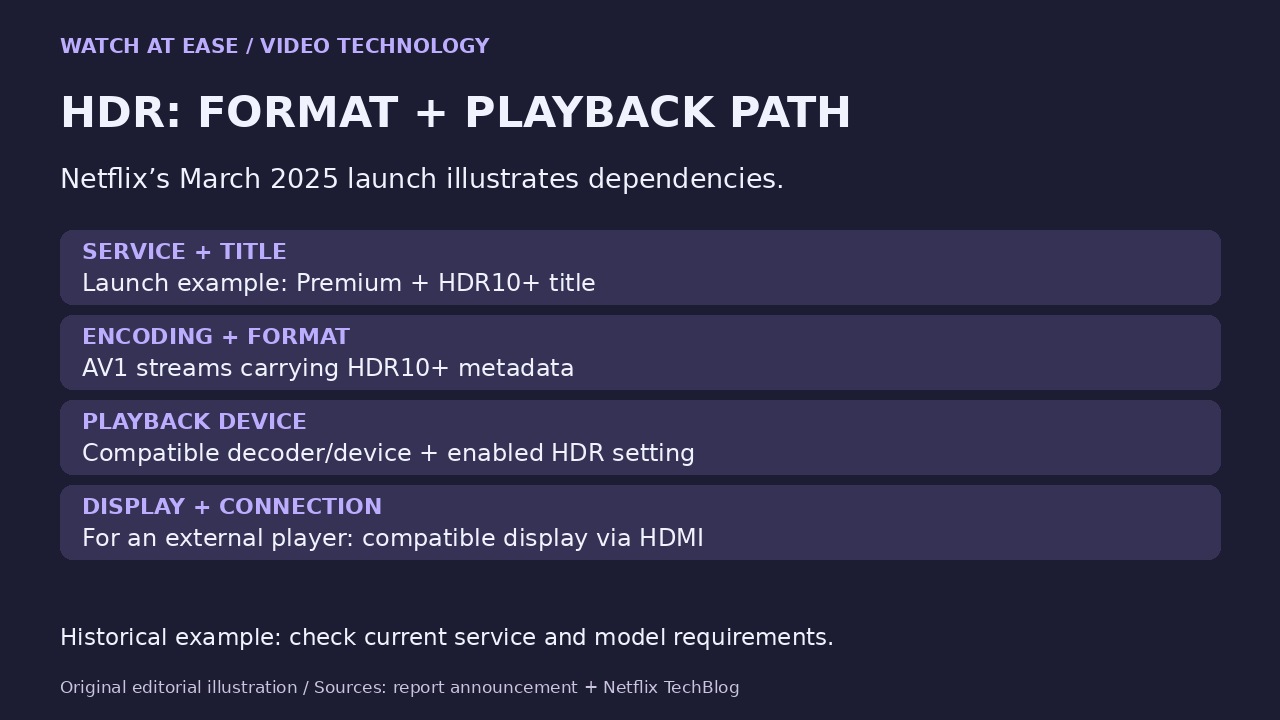
The practical point is not that every screen now shows an identical HDR picture. A format has to reach a compatible playback path, and service requirements still matter. Netflix’s dated engineering account of its HDR10+ rollout provides a concrete example of those separate dependencies.
Read the announcement at the level of evidence supplied
The release describes HDR spreading across on-demand viewing and live production, and names AI-assisted enhancement, cloud production and next-generation codecs as contributors to deployment. These are the report authors’ assessments. InterDigital is a technology developer and licensor involved in the subject, so its commercial role should remain visible.
We read the complete public announcement and the public report description. This article does not claim to have examined a full white paper not obtained in this review, reproduce its methodology, or establish a market adoption percentage. The announcement’s expectation that HDR becomes more routine is not a universal device-compatibility result.
The HDR format is one part of the picture
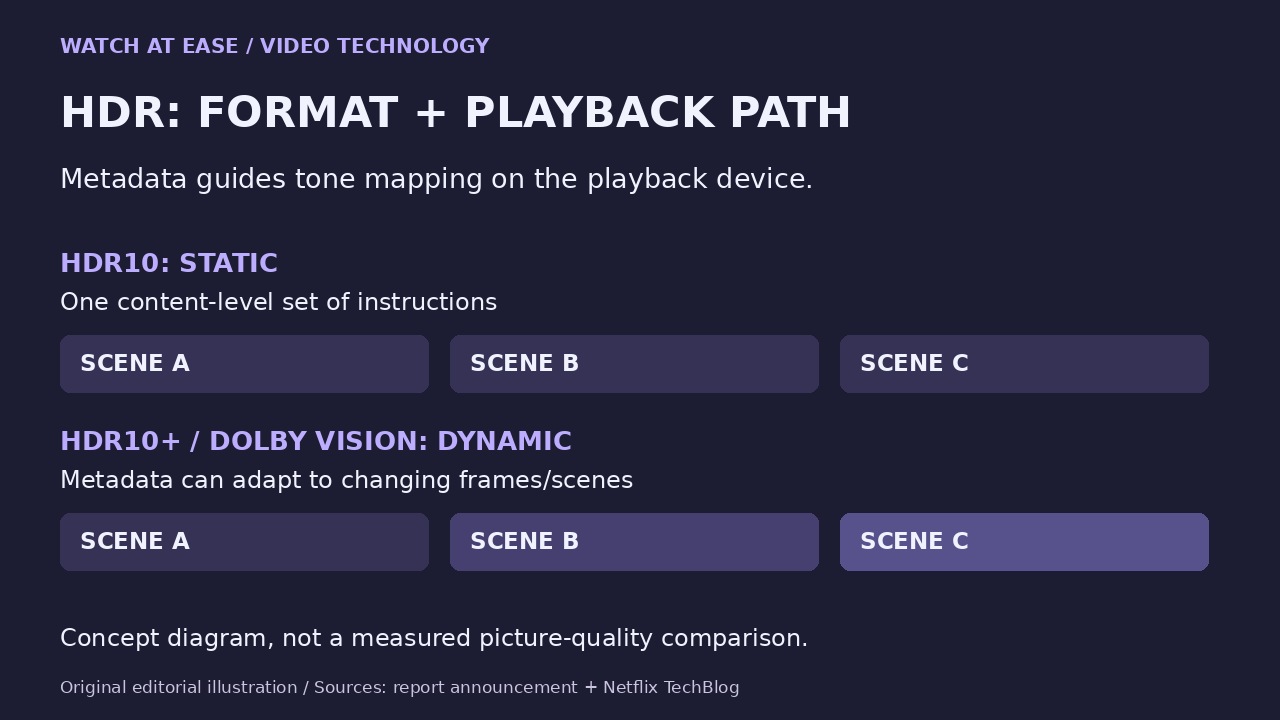
Netflix’s March 24, 2025 engineering explanation distinguishes HDR10’s static metadata, set once for the content, from dynamic metadata used by HDR10+ and Dolby Vision. Dynamic information lets a playback device adapt tone mapping to changing scenes rather than relying only on one overall set of instructions.
That explains a mechanism, not a guarantee that one branded television always looks better. Netflix itself notes that still photographs converted to standard dynamic range are a limited way to convey an HDR improvement. Our graphics therefore show concepts and dependencies, not simulated before-and-after proof of picture quality.
A dated rollout shows why the whole path matters
When Netflix announced HDR10+ in March 2025, it listed several conditions: a Premium subscription, a title available in HDR10+, a device supporting AV1 and HDR10+, and an enabled HDR setting on relevant TV or streaming-device apps. For an external source device, its example also required a compatible HDR10+ display connected over HDMI.
This is a historical example of a service joining encoded content, format metadata, a decoder and a display. It is not a current model-by-model buying list or a claim that every 2025 plan term remains unchanged. The same article’s year-end catalogue-expansion target was a plan at publication; we do not report that old target as independently verified completion today.
What to check before replacing equipment
Start with the specific service, title and app you intend to use. Confirm their current format and device requirements, then check the exact display and any intervening player or connection. Keep separate the ability to accept a signal, the selected playback format and the picture you actually observe; an HDR label alone does not settle all three.
If a setup behaves unexpectedly, record the title, app version, device model, connection and selected settings before changing one component. These are editorial verification steps drawn from the documented dependencies, not a claim that we tested your television or a universal fix. Wider industry adoption makes this end-to-end check more useful; it does not eliminate it.