Science · NEWS EXPLAINER
A white dwarf would look green up close—but this is a calculated color, not a direct photo
WD J1330+6435 is the first star credibly identified as green. Spectra and a human-vision model produce the chartreuse result; the star itself is unresolved from Earth.
A peer-reviewed study published October 15 identifies WD J1330+6435 as the first star that would credibly appear green to human eyes. Reuters reported the result on October 16. The finding is based on measured spectra converted through a model of human color perception, not a direct green photograph.
The distinction matters because no white dwarf is close enough for astronomers to resolve its stellar disc and see its true color directly. The study asks what the integrated starlight would look like if a viewer could get close enough.
What the researchers actually measured
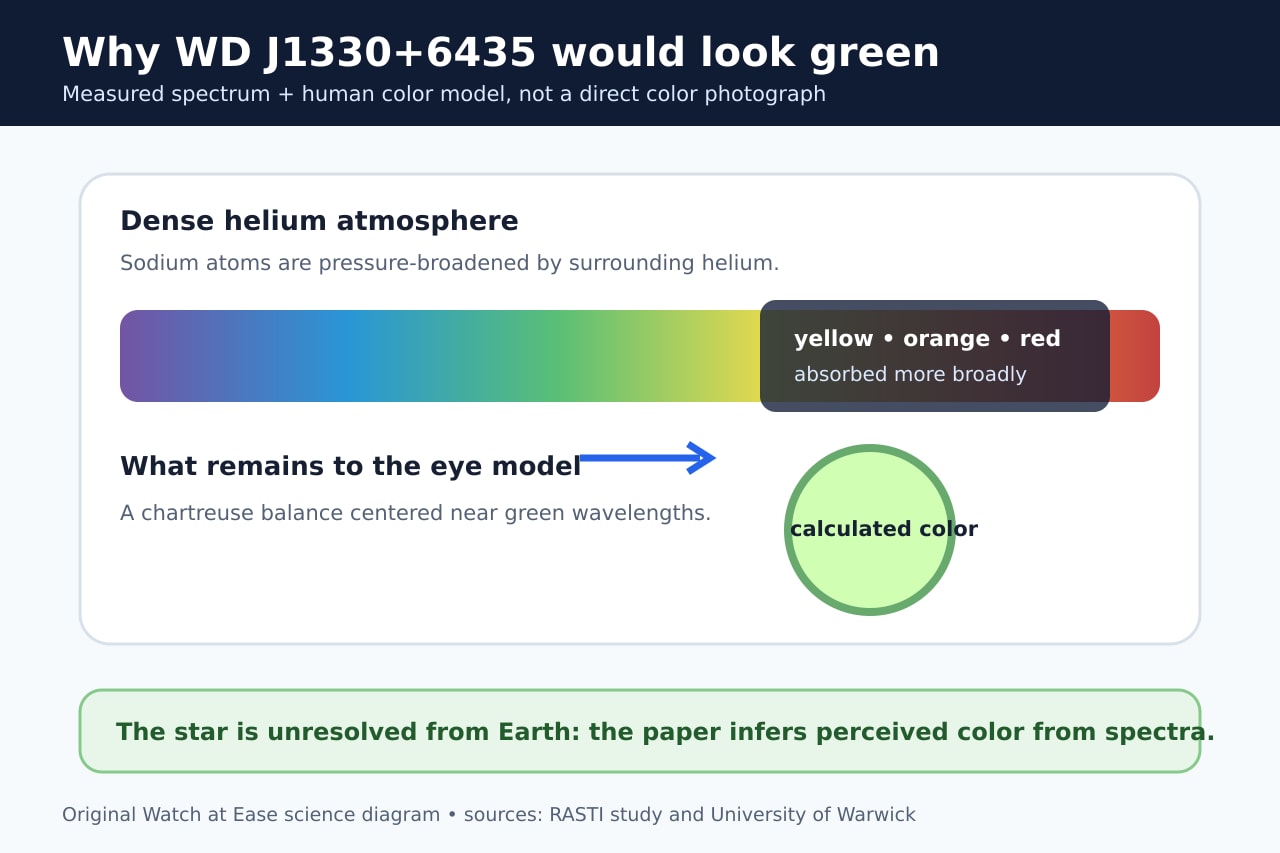
Astronomers used spectra—measurements of how much light arrives at each wavelength—and passed them through a standard model of human color vision. That calculation indicates how the unresolved star would appear if its disc could be viewed up close. The available imagery is illustrative or simulated; it is not a direct color-resolved portrait.
Why this white dwarf breaks the normal color rule
WD J1330+6435 is a cool white dwarf whose atmosphere contains calcium, lithium and especially sodium from rocky planetary debris that fell onto the star. In its extremely dense helium atmosphere, collisions broaden sodium absorption beyond a narrow orange line into yellow, orange and some red wavelengths. Calcium also suppresses violet light, leaving a chartreuse balance in the model.
Keep the 151-star sample separate
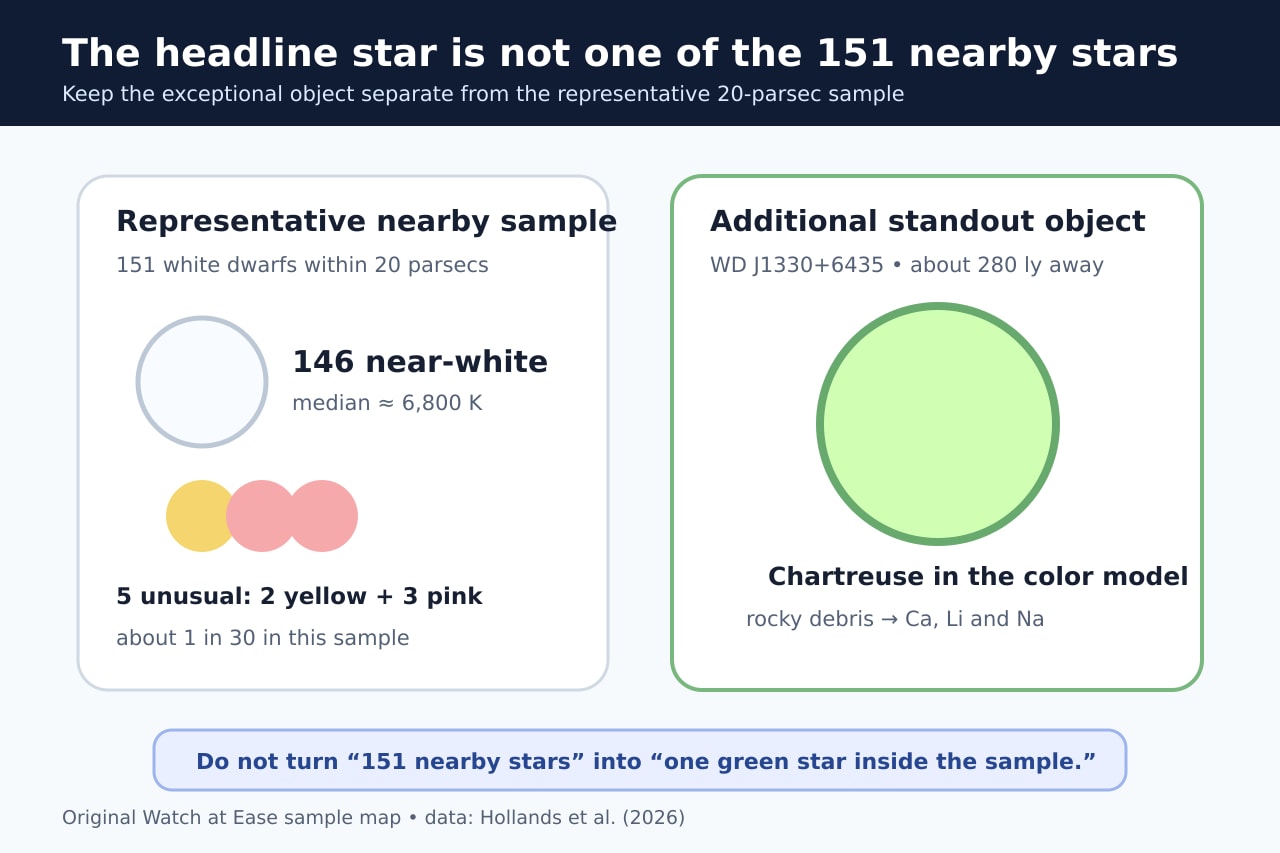
The team separately analyzed 151 white dwarfs within 20 parsecs, about 65 light-years. Five had unusual colors—two yellow and three pink—while the median was about 6,800 K and appeared white. WD J1330+6435, roughly 280 light-years away, was an additional standout object rather than the green member of that nearby representative sample.
What “first green star” does and does not mean
The authors say no other living or dead star has been credibly reported as green. That is a claim about perceived integrated light after spectral modeling, not a claim that a telescope captured a resolved green surface. It also does not mean most white dwarfs are colorful: the representative sample was overwhelmingly near-white.
What this teaches about dead stars
White dwarfs are Earth-sized stellar remnants with extraordinary density. Their atmospheric chemistry can reshape broad parts of the visible spectrum, so color carries information about accreted planetary debris or material mixed up from a star’s interior. The same work identifies carbon-rich pink and purple examples and a salmon-pink candidate for the reddest perceived star.