Tech · NEWS EXPLAINER
Genie 4 adds sound and live scene edits, with access still in research preview
Google DeepMind's new world model generates audio alongside interactive scenes. The practical questions are who can use it and how long the world stays coherent.
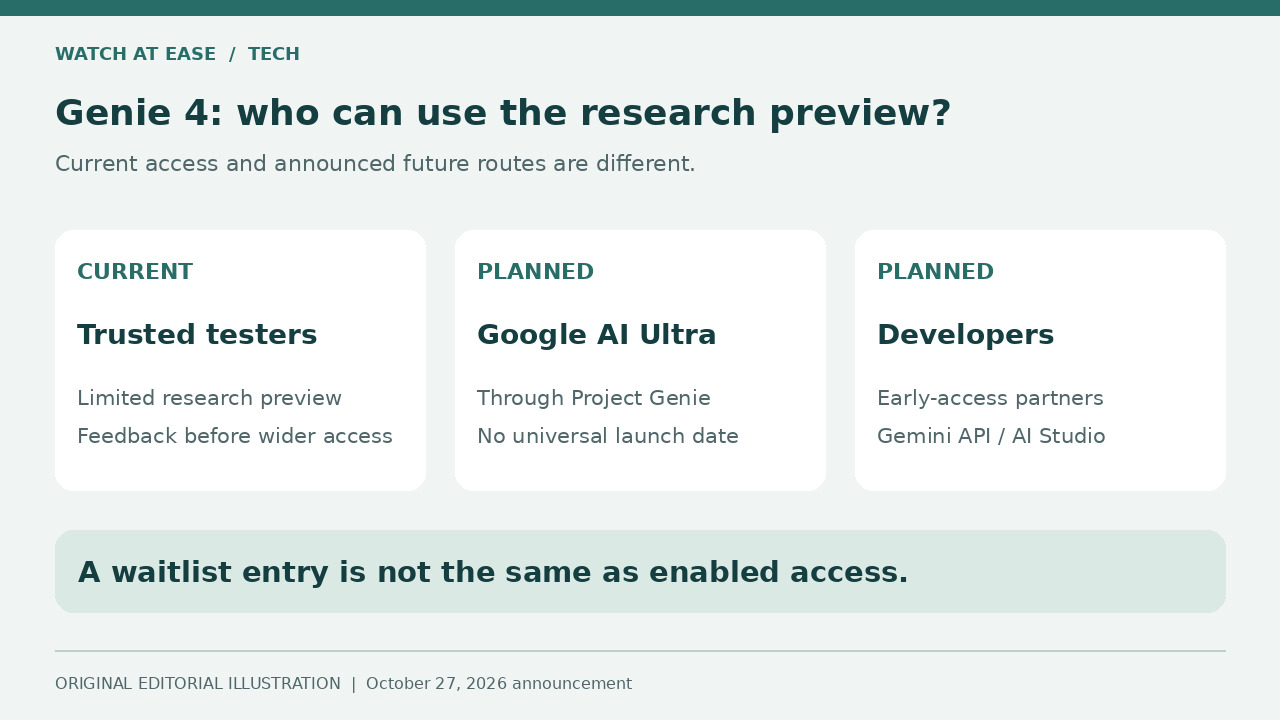
Google DeepMind announced Genie 4 on October 27, adding native audio and live scene changes to its interactive world model. The release is a research preview for trusted testers; wider consumer and developer access is still planned.
Google says users can change weather, move a camera or introduce a character through text while a world is running. Ambient sound, music and dialogue are generated with the scene. These are the company's described capabilities, not results of a hands-on test by this publication.
Check access before planning a project
The announced next groups are Google AI Ultra subscribers using Project Genie and early-access partners using the Gemini API or Google AI Studio. A waitlist is available, but the announcement does not give a universal launch day or promise that every subscriber can already open Genie 4.
Keep the model announcement separate from account eligibility. Confirm the product, country, account access and usage terms shown to you before scheduling a production workflow. An existing subscription or a waitlist entry is not evidence of an enabled feature.
A scene that responds while it is being generated
The central interaction is an evolving environment that responds to new inputs. Google describes Gemini Omni as grounding appearance and behavior, while other Gemini models help plan and monitor events. This supports experiments with camera movement, action and dialogue within one developing scene.
That makes short concept trials a plausible use: change one element, observe the response and decide whether the idea is worth developing. A responsive prototype should therefore be evaluated on its actual output, not assumed to be a finished game or film tool.
Test continuity, not just the opening frame
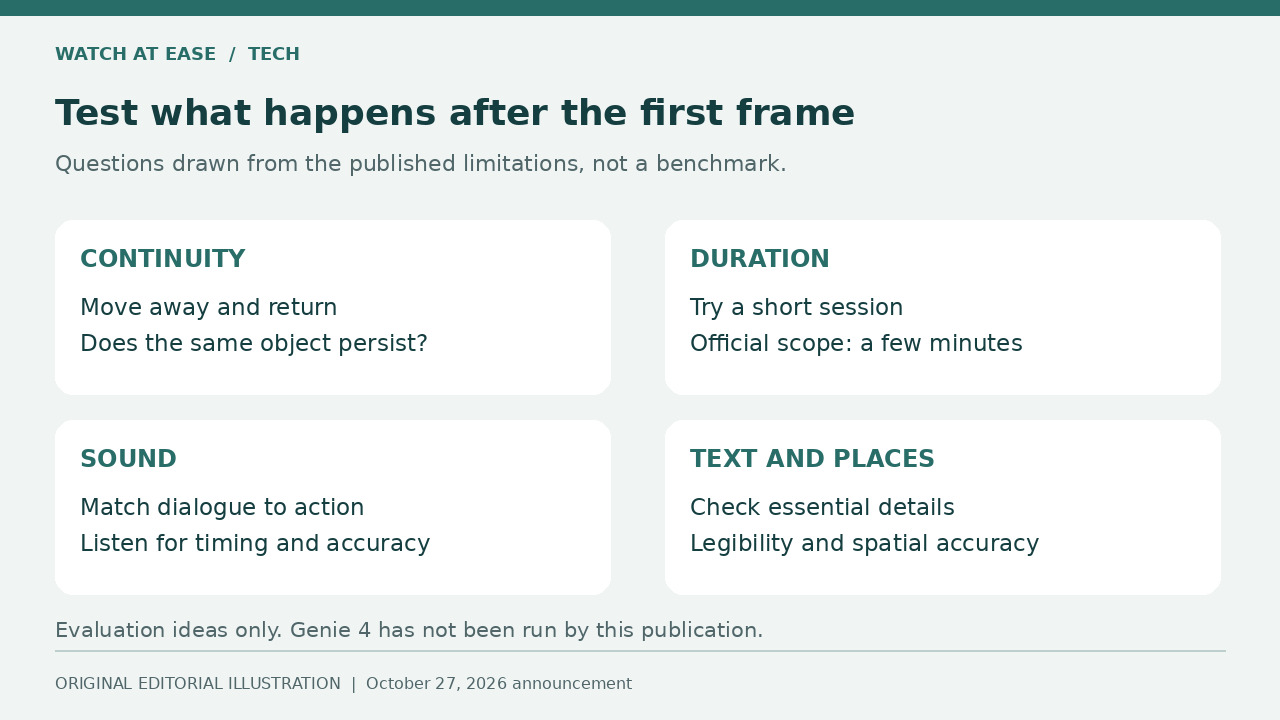
ITmedia reports a few minutes of continuous interaction. Google also warns that objects and visual details can drift, especially during longer sessions, repeated edits or movement through a scene. Complex interactions, real-world locations, legible text and accurate sound remain imperfect.
For a useful trial, record the starting scene and your edits, then inspect the same object after moving away and returning. Check whether dialogue fits the action and whether text stays readable. Those are proposed evaluation steps, not benchmark results; this report has not run Genie 4.
Keep a simulation distinguishable from a recording
DeepMind says generated video and audio will include SynthID watermarks. Its demonstrations are labeled illustrative and shortened. A generated scene can explore an idea, but its realism alone does not establish that a depicted event happened.
If a prototype enters an editorial, teaching or creative workflow, retain its generation context and label the simulated material. Decide which details need verification before reuse. The announcement opens an experiment; dependable use still requires checking the specific output and access conditions.