Business/Technology · NEWS EXPLAINER
Google challenges EU orders on Android AI access and Search data sharing
Google has appealed two Digital Markets Act orders to the EU General Court. One expands rival AI assistants’ access to Android features; the other requires anonymised Search data sharing with eligible rival search services.
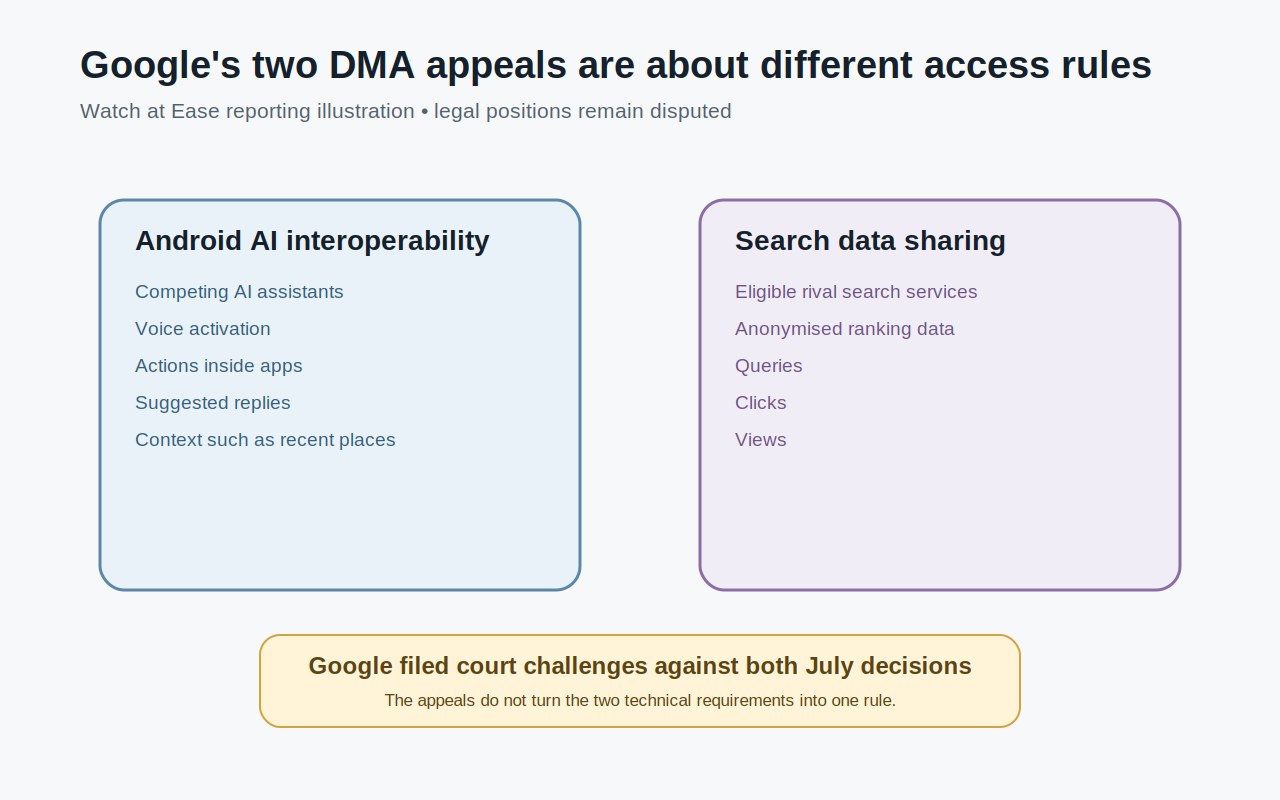
Google has challenged two European Commission orders that would change how rivals can use Android features and Google Search data in the European Union. Reuters reported on September 29 that Google filed the challenges with the EU General Court a day earlier, while the Wall Street Journal independently confirmed appeals covering the same two July Digital Markets Act decisions.
The disputes are different even though both concern access to Google-controlled systems. The Android order is about interoperability for competing AI assistants. The Search order is about sharing anonymised ranking, query, click and view data with eligible rival search engines, including AI chatbots that provide search functions.
One appeal is about rival AI assistants on Android
The Commission says rival AI assistants currently have more limited access to Android functionality than Google's own AI services. Its July decision is intended to give competing assistants access to features needed to operate on more equal terms with Gemini.
The Commission gives practical examples: a user could activate a preferred assistant by voice, let it carry out actions inside apps, receive suggested replies in chat applications, or ask about a recently visited place. Google says the required opening of Android would weaken security protections; that is the company's position in the dispute, not an established court finding.
The other appeal is about anonymised Search data
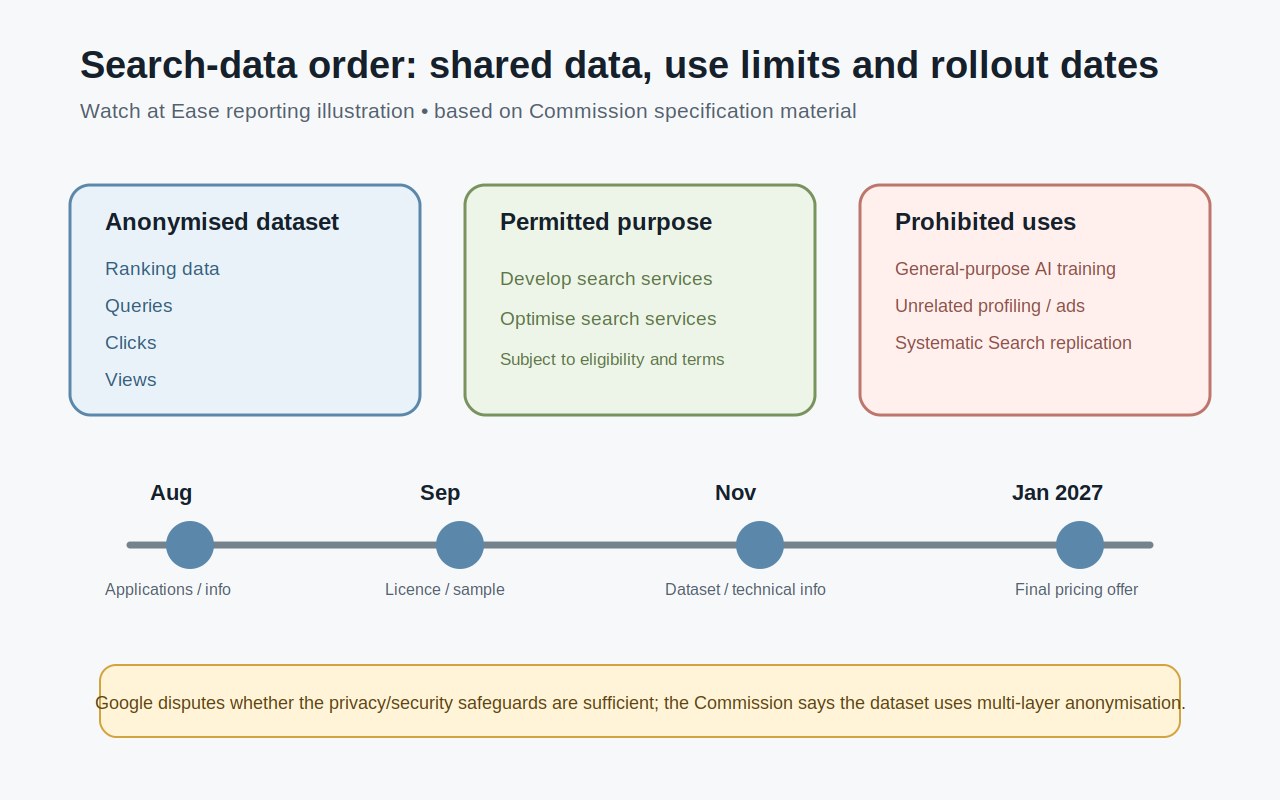
The second order implements the DMA's search-data sharing obligation. The Commission says eligible rival search engines should receive anonymised ranking, query, click and view data collected by Google Search, and that AI chatbots offering search functionality can qualify as recipients.
The Commission also limits what recipients may do with the dataset. It says the data may support search-service development and optimisation, but cannot be used to train general-purpose AI models, build unrelated consumer profiles or advertising products, or systematically copy Google's search results.
Privacy is the central factual dispute in the Search appeal
Google's public argument is that Search contains highly personal queries and that the Commission's order does not provide enough anonymisation or security protection. Reuters quotes Google competition executive Oliver Bethell warning that sharing private search history without adequate safeguards could harm users.
The Commission describes a different assessment. Its July decision says the Search dataset uses a multi-layer anonymisation method developed with privacy expertise, and it allows Google to assess serious cybersecurity or data-protection risks before sharing data with a specific third party. The court process will test the legality of the Commission's decisions; this report does not resolve the technical or legal disagreement itself.
The implementation calendar is already staged
The Search-data decision uses a staged implementation calendar. The Commission required initial application and information steps in August, licence and test-sample work by September, finalisation of the anonymised dataset and technical information by November, and a final pricing offer by January 2027.
For Android, the Wall Street Journal reports a July 2027 deadline for the changes. Reuters says the challenged measures are due to take effect next year. The reviewed sources do not establish that filing the appeals by itself suspends those requirements, so the practical effect of the court cases on timing remains something to verify in later legal or Commission updates.