Science · NEWS EXPLAINER
Astronomers identify first known green star—and explain why it looks chartreuse
WD J1330+6435 is a dense white dwarf whose sodium-rich, helium atmosphere removes yellow, orange and some red light. The result is a rare chartreuse appearance—not a normal temperature color.
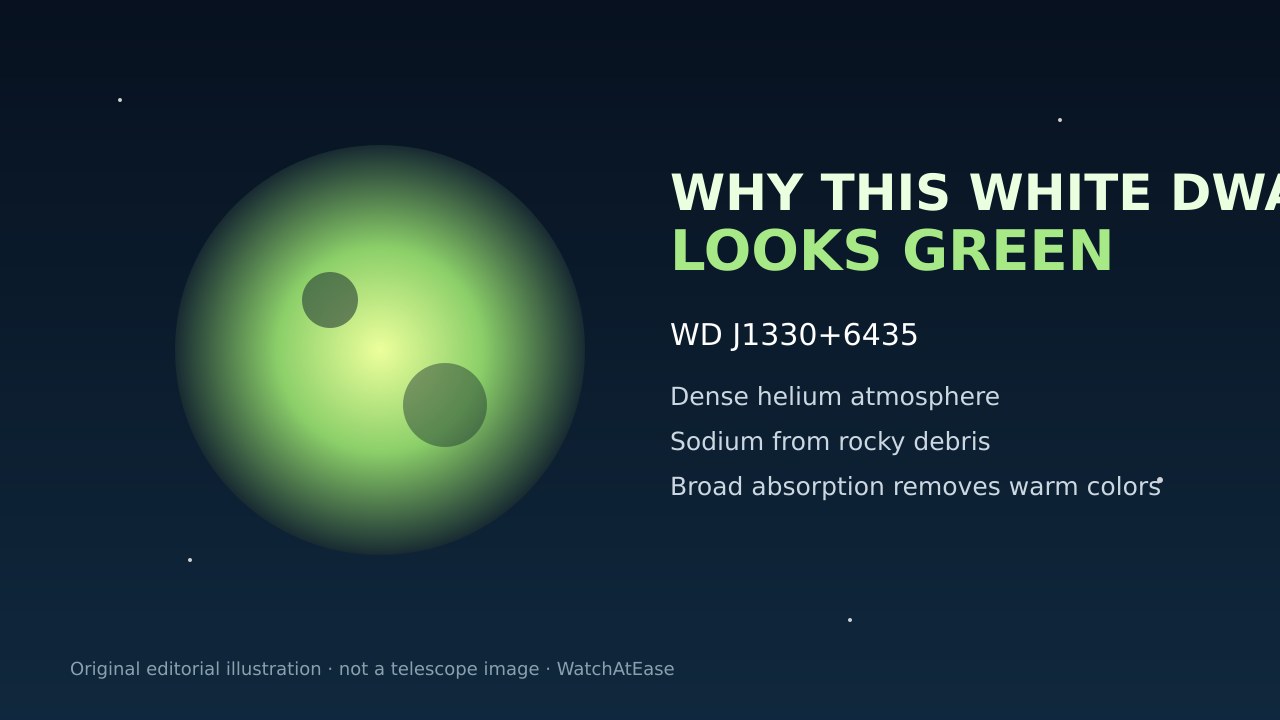
Astronomers have documented what researchers describe as the first credible green star: WD J1330+6435, a white dwarf in the Milky Way. Its color is not produced by the temperature sequence that makes ordinary stars look orange, white or pale blue.
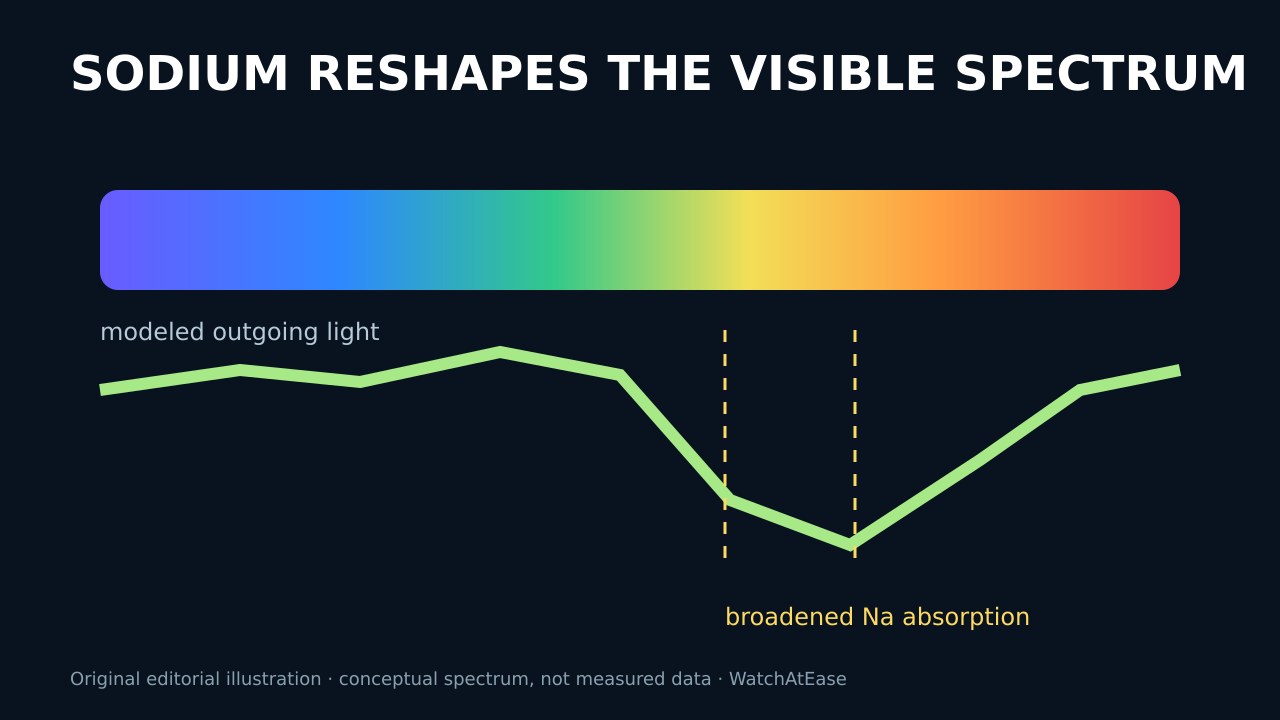
The chartreuse tint comes from chemistry under extreme pressure. Rocky planetary debris enriched the remnant with sodium, calcium and lithium; collisions between sodium and helium atoms broaden the wavelengths sodium absorbs, leaving more green light in the spectrum that reaches an observer.
Why a star can look green
For most stars, apparent color tracks surface temperature. A white dwarf is different because its Earth-sized body contains a large fraction of a star’s mass, creating a dense atmosphere where pressure changes how atoms interact with light. In WD J1330+6435, sodium no longer removes only a narrow orange wavelength: collisions with helium broaden the absorption across yellow, orange and part of the red spectrum, so the remaining visible mix appears chartreuse.
The planetary-debris connection
The white dwarf has accreted rocky material left from its former planetary system. That debris supplied calcium, lithium and especially sodium to its outer layers. The evidence therefore links the unusual color to both the star’s high-density atmosphere and the chemical record of disrupted planets; it does not mean an ordinary living star has changed temperature and turned green.
What the wider survey found
The color project examined 151 white dwarfs within roughly 65 light-years to model how human eyes would perceive them, while also discussing unusual objects outside that local sample. Most remained white, but atmospheric composition produced yellow, cyan, pale blue, pink and purple groups. WD J1011+2845, about 48 light-years away, may be among the reddest known stars because carbon brought up from its interior produces a salmon-pink appearance.
What remains uncertain
The two current reports give different distance estimates for WD J1330+6435—about 280 and 326 light-years—so readers should treat the exact distance as unresolved pending a single cited measurement in the study record. The more important confirmed result is spectroscopic: sodium absorption modified by the dense helium environment explains the first credible chartreuse star. Illustrations in this article are explanatory artwork, not telescope photographs of the star’s true visual disk.