Technology · NEWS EXPLAINER
A 25-year cryptography mystery points to timestamps—not a new ECDSA break
Researchers reconstructed how several standardized elliptic-curve seeds were generated from an old C random-number generator and 1997–98 timestamps. The result makes a deliberate backdoor less plausible, but it does not expose private keys and leaves important choices unexplained.
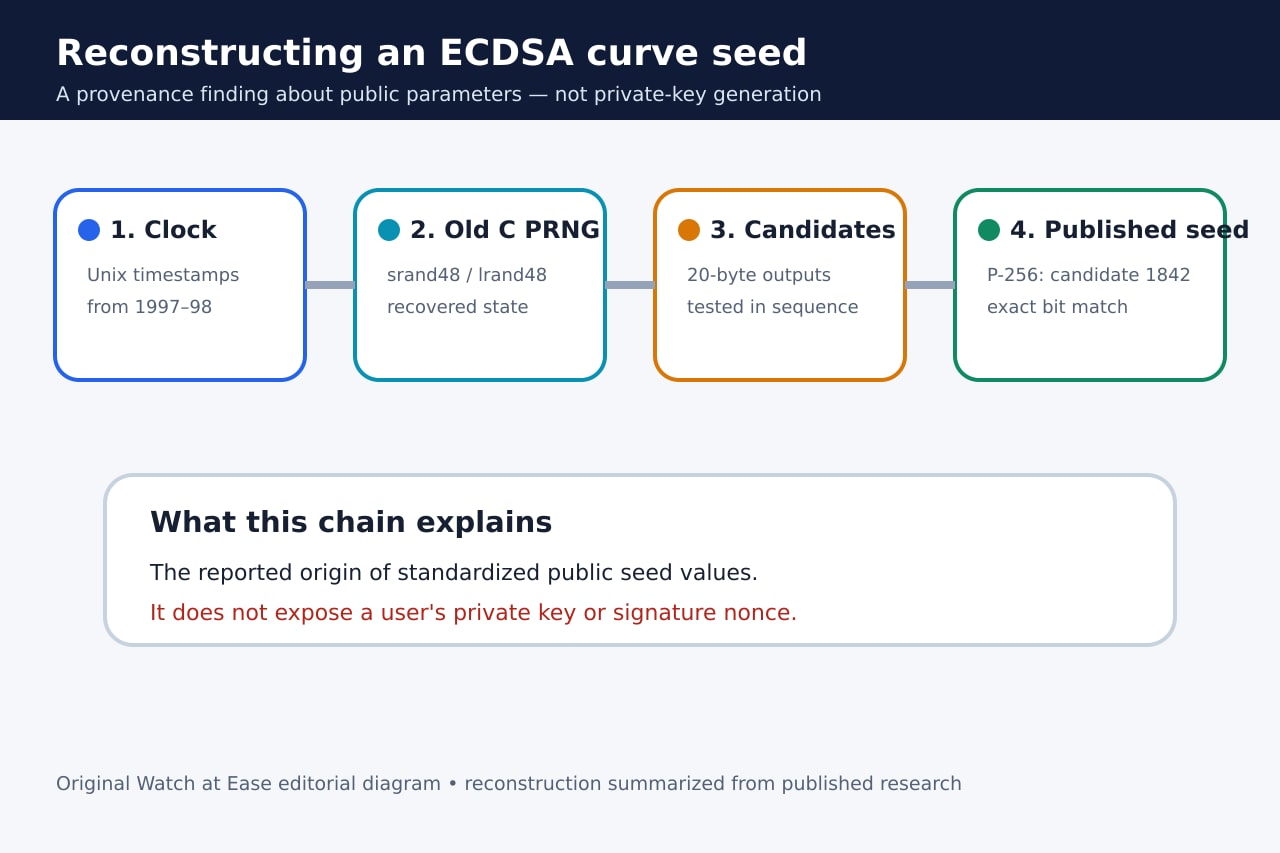
A newly published reconstruction links several standardized elliptic-curve seed values to the C library generator lrand48, initialized from Unix timestamps in 1997 and 1998. Anthropic says its researchers recovered generator states and reproduced the published values bit for bit.
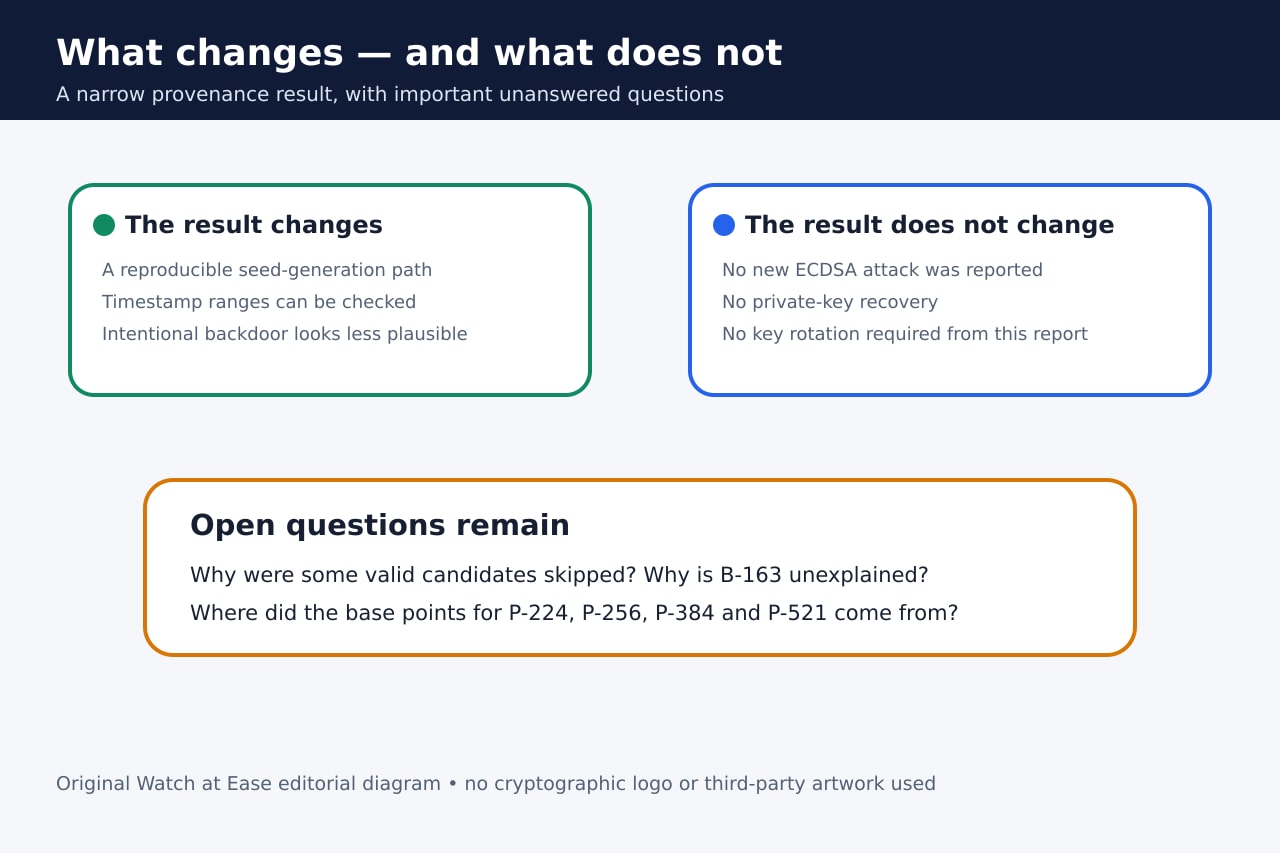
This is a provenance result, not a new way to break ECDSA. A curve seed helps document how public parameters were selected; it is not a user’s private key or the per-signature secret nonce. The researchers say the finding requires no action from users.
What the researchers reconstructed
The team searched the published seeds for patterns associated with software available in the late 1990s. Zero-bit patterns pointed toward lrand48; lattice reduction was used where only part of each generator output appeared in the seed.
The recovered states reproduced five NIST prime-curve seeds and five ANSI example-curve seeds. Running the generator backward produced initialization values corresponding to dates from May 1997 to April 1998. Anthropic published reproduction code for independent checking.
A seed is not your cryptographic secret
These seeds belong to the public process used to derive or justify standardized curve parameters. They are different from the private key held by a person or server and from the secret nonce used when making an ECDSA signature.
The researchers explicitly describe the result as neither a break nor a new attack. The current report provides no basis to rotate certificates, cryptocurrency keys or signing keys solely because of this discovery. Normal patching, key-management and standards guidance still apply.
Why the result matters without proving intent
A simple reproducible generator path offers a mundane explanation for values whose unexplained origin had fueled suspicion. That makes deliberate parameter manipulation less plausible, according to the researchers, but provenance alone cannot establish the motives of the people who chose the final curves.
NIST’s current SP 800-186 still specifies recommended elliptic curves for U.S. government use. The new research examines the historical origins of several parameters; it does not announce a change to that standard.
What is still unresolved
The reconstruction does not explain the B-163 seed or the base points for P-224, P-256, P-384 and P-521. It also found cases where an earlier candidate appeared to satisfy the stated requirements but was skipped.
For P-256, candidate 876 apparently qualified, while candidate 1,842 became the published seed. Until the selection criteria and missing base-point origins are explained, the strongest conclusion is narrow: much of the seed-generation process is reproducible, but not every design choice is known.