Technology · NEWS EXPLAINER
DeepSeek V4.1-Flash-1017 is live: what changed and what developers should verify
DeepSeek’s October 17 checkpoint is live on its website, app and API, with MIT-licensed weights on Hugging Face and newly opened Search and Fetch APIs. The benchmark gains are vendor-reported, so teams should test prompt encoding, tool behavior, latency and total cost on their own workloads.
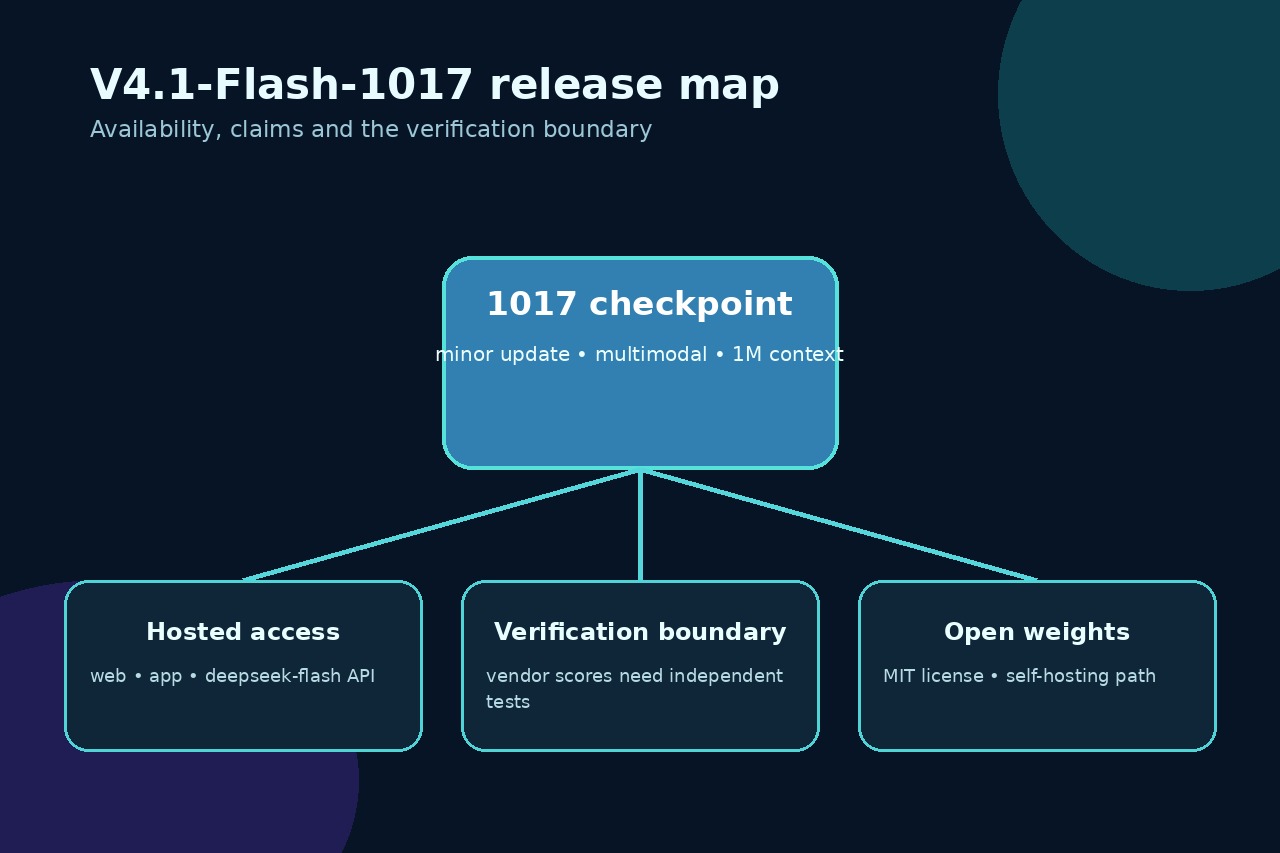
DeepSeek released V4.1-Flash-1017 on October 17 as a minor update to V4.1-Flash. The company says the checkpoint improves reasoning, coding, agentic and visual benchmark results while shortening task time and output. The update is available through DeepSeek’s website, app and the existing deepseek-flash API name, and the model card provides MIT-licensed weights for self-hosting. DeepSeek also opened Search and Fetch APIs to developers.
What actually shipped
The official model card calls 1017 a minor checkpoint update rather than a new architecture. It lists text and image input, text output, a one-million-token context window and recommended sampling settings of temperature 1.0 and top-p 1.0. The repository is tagged with the MIT license and includes weight files plus deployment instructions for Transformers, vLLM and SGLang. Hosted users do not need a new model identifier: independent launch coverage says the existing deepseek-flash API name now serves the update.
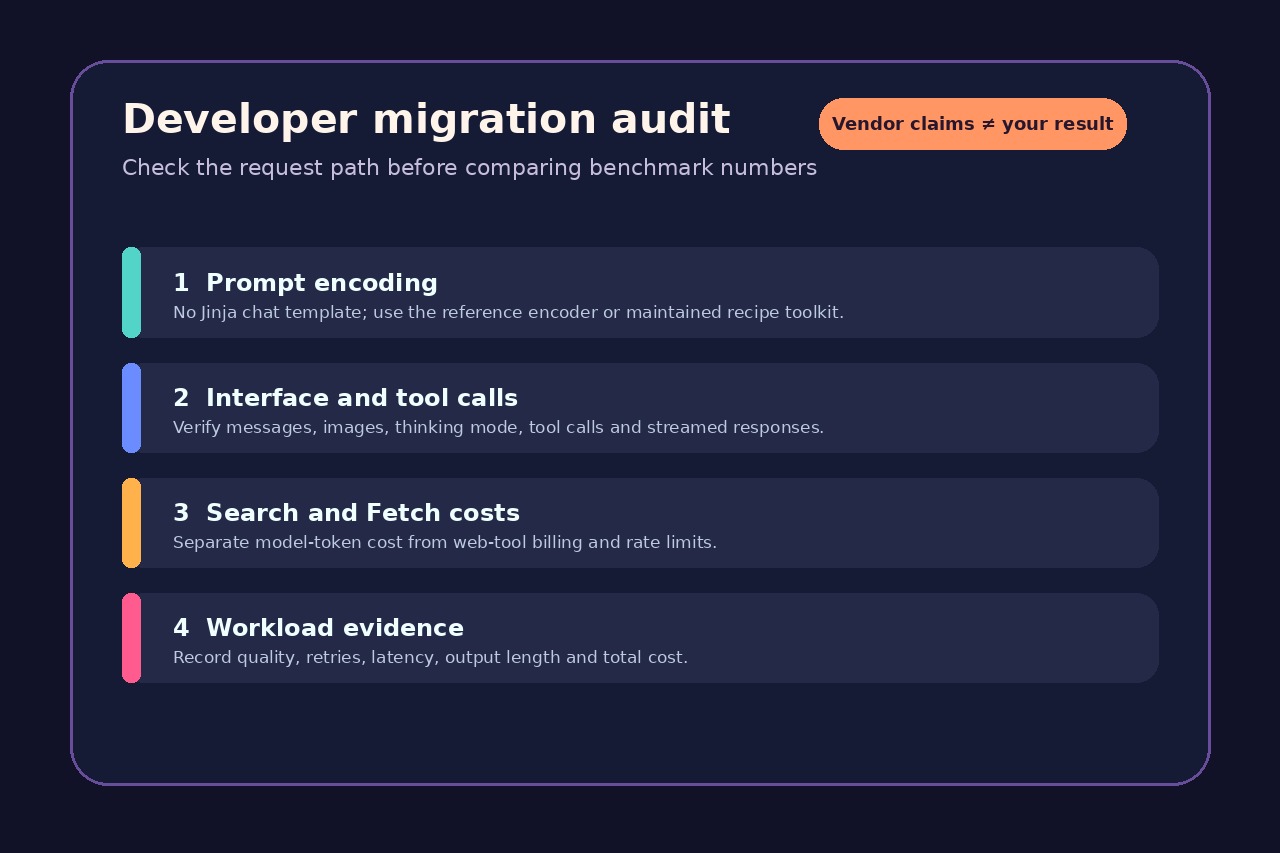
The same release expands DeepSeek’s developer stack. MarkTechPost and Dealroom report that Search and Fetch are now available to all developers. Search returns ranked results, while Fetch returns a selected page as Markdown. These tools are separate from model inference, so teams should treat model tokens, web-tool requests and any temporary promotion as distinct cost lines.
The benchmark table is a claim, not an independent verdict
DeepSeek reports that 1017 improves on the September V4.1-Flash checkpoint across its eleven listed benchmarks. Its table shows DeepSWE v1.1 rising from 74.2 to 77.0 and Terminal-Bench 4.0 from 31.2 to 42.3. It also shows Claude Opus 5 ahead on HLE without tools, Terminal-Bench, ProgramBench and NL2Repo-Bench. MarkTechPost explicitly labels the figures as DeepSeek’s own results, and Dealroom likewise attributes the comparison to DeepSeek.
Those caveats matter because benchmark scores depend on harnesses, prompts, tool availability and pass rules. The model card says Terminal-Bench used the Claude Code harness and DeepSWE used Mini-SWE-V2. A team should not infer that 77.0 guarantees better repository work, fewer retries or lower total cost in its environment. The useful conclusion is narrower: DeepSeek claims a stronger checkpoint, and the files are available for reproducible testing.
Prompt encoding is the first compatibility check
The model card warns that the release does not include a Jinja-format chat template. Instead, the encoding folder contains a Python reference implementation with test cases for multi-turn conversation, tool calls, thinking mode, numeric reasoning effort, mid-conversation system messages and interleaved images. DeepSeek also points production users to deepseek-recipe, a maintained Rust toolkit with Python bindings.
Before comparing output quality, verify that the same conversation is serialized the same way in the old and new paths. Record system-message placement, image ordering, tool-call arguments, tool results, thinking settings, stop conditions and streamed response parsing. A mismatch in any of those layers can look like a model regression even when the checkpoint is not the cause.
Hosted and self-hosted tests answer different questions
Hosted access is the fastest way to test whether the update changes output quality, latency or token use for an existing integration. Self-hosting tests deployment feasibility, memory needs, quantization trade-offs and throughput on a specific system. The Hugging Face page lists a large checkpoint and says no listed inference provider currently hosts that repository directly, so local deployment should not be described as a laptop-class download without hardware evidence.
Create a small evaluation set from real tasks. For each task, record success criteria, output quality, retries, input and output tokens, tool calls, elapsed time and failures. Compare the same prompt encoding and the same external tools. For coding work, include repository navigation, edits, tests and recovery from a failed command rather than relying on a single generated function.
A practical migration checklist
First, confirm whether the hosted deepseek-flash endpoint in your account now reports or behaves like the 1017 checkpoint. Second, pin the open-weight repository revision if reproducibility matters. Third, validate the reference encoder or deepseek-recipe before testing tools and images. Fourth, separate token charges from Search and Fetch request charges and note the rate limit. Fifth, run representative tasks and keep raw outputs so reviewers can distinguish model behavior from harness behavior.
Do not copy the launch table into a procurement decision without independent evidence. A safe rollout uses a limited workload, explicit rollback, privacy review for hosted requests and a cost ceiling. The release is material because a live checkpoint, weights and web-tool endpoints became available together; its real advantage remains workload-specific until independent tests reproduce the claims.