Business/Consumer · NEWS EXPLAINER
China manufacturing PMI rises to 50.1 in September; private gauge hits 52.1
China's official manufacturing PMI rose to 50.1 in September from 49.8 in August, moving just above the line that separates expansion from contraction. A private RatingDog survey reported a stronger 52.1 reading, while official sub-indices showed faster production but still-soft factory employment.
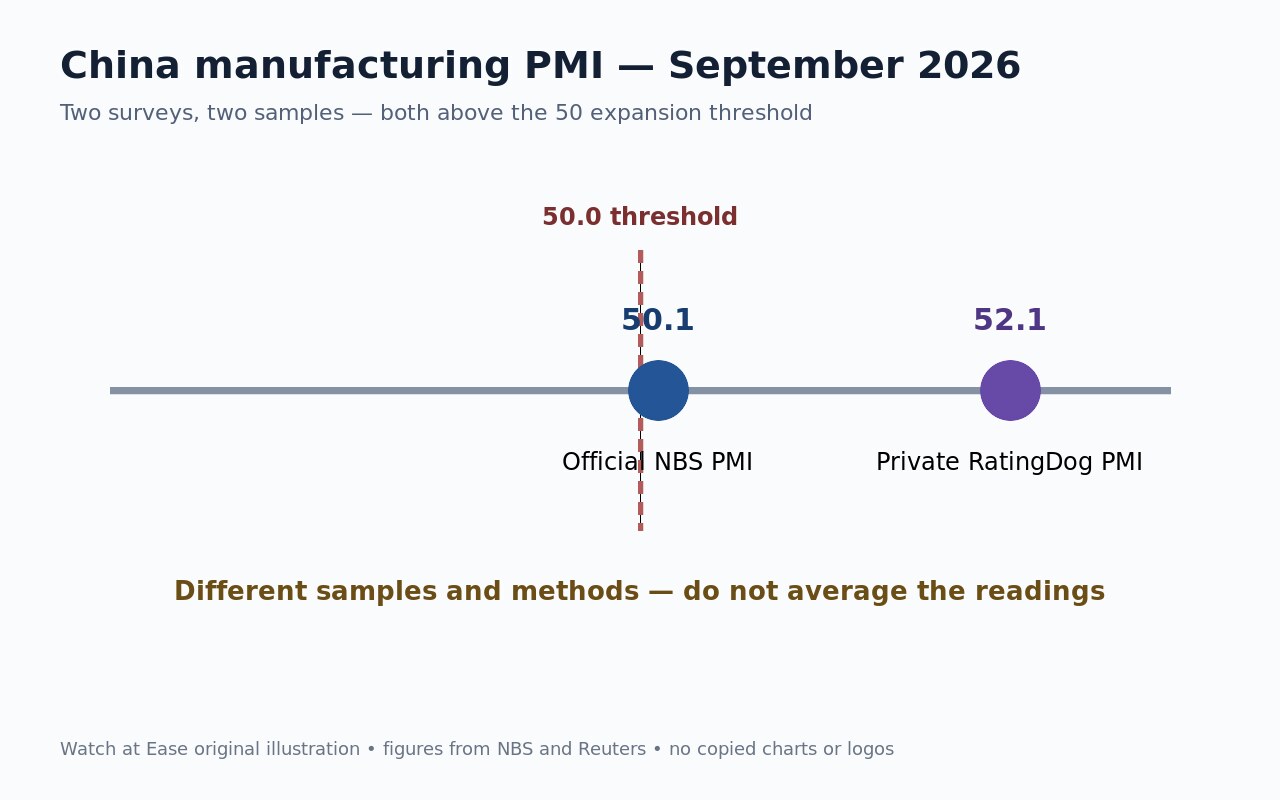
China's official manufacturing activity gauge moved back into expansion territory in September, but only narrowly. The National Bureau of Statistics said the manufacturing Purchasing Managers' Index rose to 50.1 from 49.8 in August, putting it just above the 50.0 threshold that separates month-on-month expansion from contraction.
A private survey showed a stronger signal. Reuters reported that the RatingDog China General Manufacturing PMI rose to 52.1 from 51.5 in August, a five-month high. The two surveys use different company samples and methodologies, so the gap between 50.1 and 52.1 should be read as two views of factory conditions rather than a contradiction.
What a 50.1 PMI actually means
PMI surveys are diffusion indices: readings above 50 indicate month-on-month expansion in the surveyed activity, while readings below 50 indicate contraction. The official September reading of 50.1 therefore signals a return to expansion, but by only one tenth of a point above the threshold.
The NBS said 12 of the 21 manufacturing industries it surveys were above 50 in September, four more than in August. That suggests the improvement was somewhat broader across industries even though the headline index itself was only barely positive.
Production accelerated, but hiring stayed weak
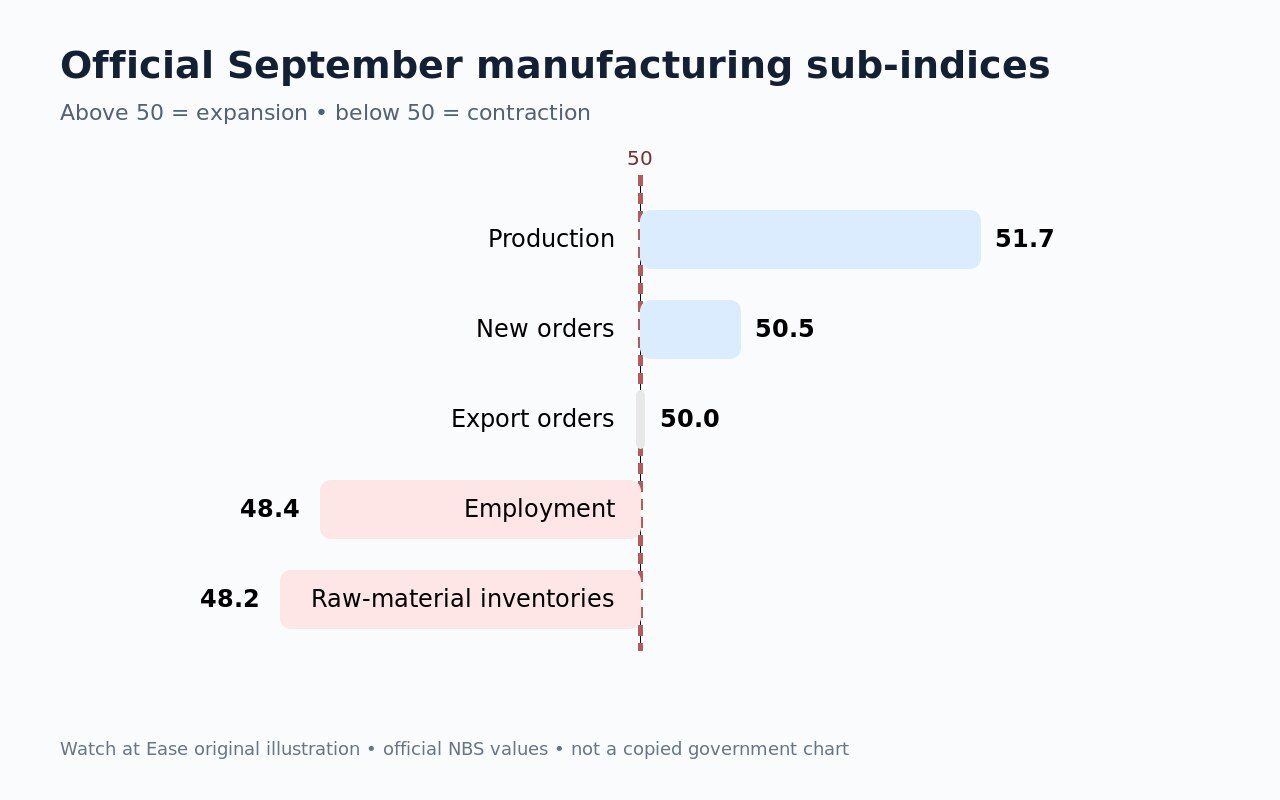
The strongest official sub-index move was production. It rose to 51.7 from 50.4, indicating faster expansion in factory output. New orders stayed positive at 50.5, although that was 0.1 point lower than in August.
Other indicators were less strong. The employment index fell to 48.4, remaining in contraction, and raw-material inventories were 48.2. New export orders were exactly 50.0, while imports were 49.2. Those readings are why a 50.1 headline should not be treated as evidence that every part of manufacturing strengthened.
Why the private PMI can look stronger than the official survey
Reuters said the RatingDog China General Manufacturing PMI rose to 52.1 from 51.5, a five-month high. Private and official China PMI surveys do not use identical company samples or survey designs, so they can produce different readings in the same month.
The useful comparison is direction rather than forcing the two numbers into one average. Both the official 50.1 reading and the private 52.1 reading point to improved factory conditions in September, while the private survey signals a more pronounced expansion.
The broader recovery is still uneven
Reuters linked some of the September improvement to easing weather disruptions after heavy rain and typhoons, and said demand tied to the global AI boom supported parts of industry. Official data also showed non-manufacturing activity returning to expansion at 50.2 and the composite PMI output index rising to 50.7.
But Reuters cautioned that the broader economy remains uneven because consumption and investment are softer and the property downturn remains a drag. The September PMI data therefore show an improvement in business activity, not proof that every part of the economy is accelerating.