Business/Technology · NEWS EXPLAINER
Ken Griffin gives Carnegie Mellon $3 billion to launch CMU Miami and expand Pittsburgh
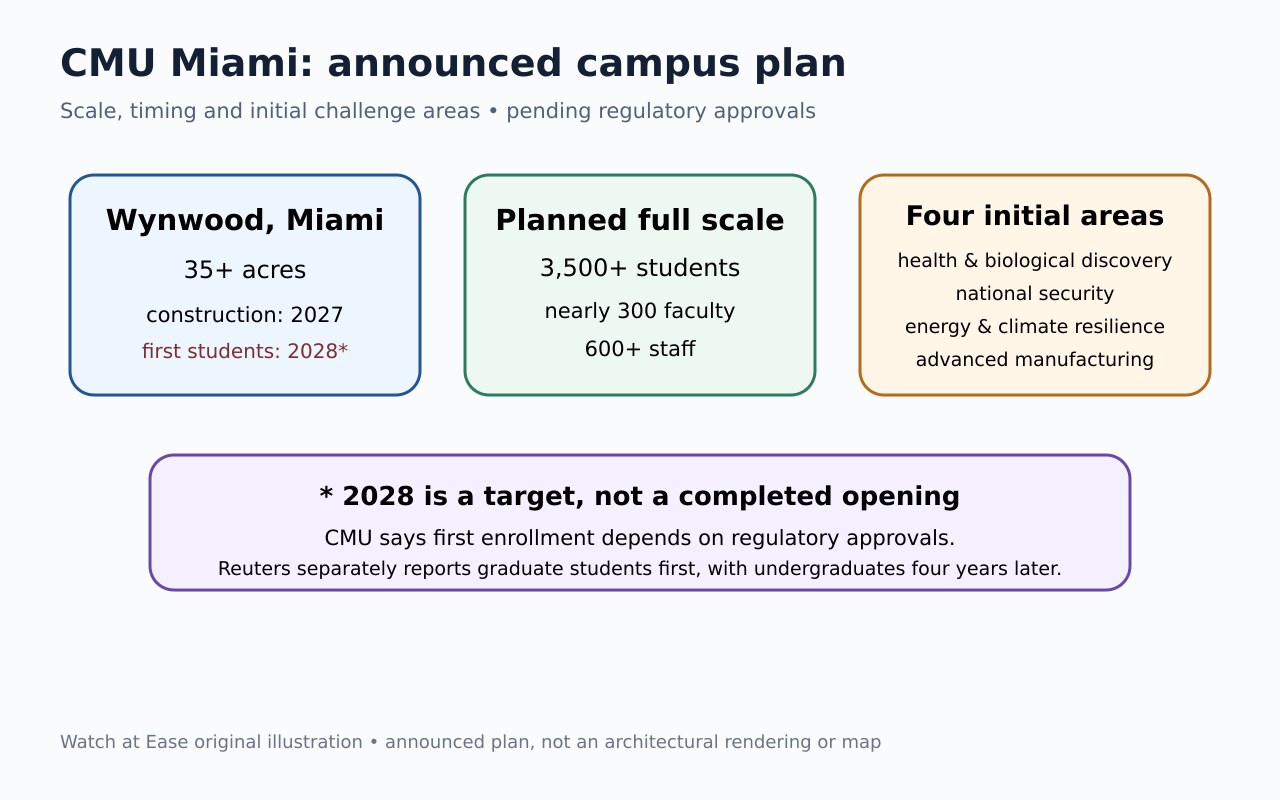
Carnegie Mellon says Ken Griffin's $3 billion gift will put $2 billion toward a new 35-acre CMU Miami campus in Wynwood and $1 billion into Pittsburgh, including $500 million for the School of Computer Science. Construction is planned for 2027, with the first Miami students expected in 2028 pending regulatory approvals.
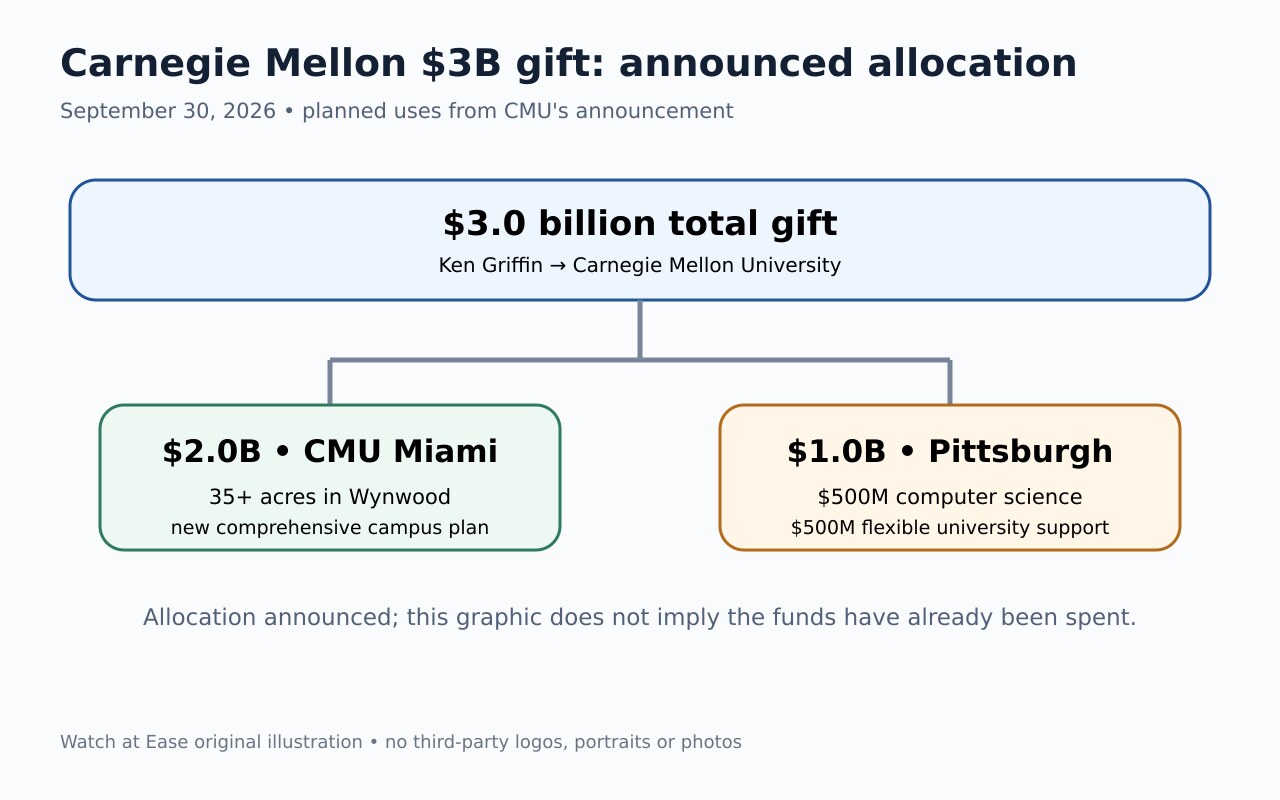
Carnegie Mellon University and Ken Griffin announced a $3 billion gift on September 30 that would finance a new campus in Miami and a major expansion of the university's Pittsburgh base. CMU says $2 billion is designated for CMU Miami, while $1 billion will support Pittsburgh, including a $500 million investment in the School of Computer Science.
The Miami campus is a plan, not an already-open school. CMU says construction is slated to begin in 2027 and that the first students could enroll in 2028, subject to regulatory approvals. Reuters and the Associated Press independently reported the same gift and campus plan.
$2 billion is earmarked for a new CMU Miami campus
The larger share of Griffin's gift is intended for CMU Miami. Carnegie Mellon says the new campus will sit on more than 35 acres in Wynwood and is meant to become a comprehensive university campus rather than a small satellite program.
The university says the completed campus would support more than 3,500 students across undergraduate, master's and doctoral programs, nearly 300 faculty and more than 600 staff. AP independently reported the 35-acre site, roughly 3,500-student scale and a construction start planned for next year.
The remaining $1 billion reinforces Carnegie Mellon's Pittsburgh base
CMU says $1 billion will stay with the Pittsburgh campus. Half of that amount — $500 million — will go to the School of Computer Science, which will be renamed the Kenneth C. Griffin School of Computer Science. The other $500 million is flexible support for the university's highest priorities.
Reuters reported that Pittsburgh priorities include attracting leading academics and making the university more affordable for students. The gift therefore funds both geographic expansion and investment in CMU's existing academic base.
CMU Miami is being organized around four cross-disciplinary challenge areas
Rather than building the Miami campus around conventional academic majors, Carnegie Mellon says it will organize learning and research around four initial challenge areas: human health and biological discovery; national security and strategic capabilities; energy and climate resilience; and advanced manufacturing and industrial transformation.
The university says those programs will draw on its strengths in computing, robotics, machine learning, science, engineering, public policy, humanities and the arts. The concept is still being built out, so the announcement establishes the operating model and broad areas rather than a final catalog of degrees.
The timeline is ambitious, but approvals still matter
CMU says construction is slated to begin in 2027 and the first students are planned for 2028, pending regulatory approvals. That condition matters: the September 30 announcement is a funding and campus-development commitment, not proof that all approvals, construction milestones or academic offerings are already complete.
Reuters reported a more detailed enrollment sequence from interviews with Griffin and CMU President Farnam Jahanian: graduate students are expected in 2028, with undergraduates four years later. CMU's main announcement states only that the first students are planned for 2028, so the safer public summary is that enrollment is intended to start in 2028 while the exact program rollout continues to develop.