Sports · NEWS EXPLAINER
Capitals beat Devils 4–2: the four-goal swing, second-period burst and Thompson’s hold
Washington answered New Jersey’s opener with four straight goals, including three by centers in the second period. Logan Thompson then made 16 third-period saves to protect the win.
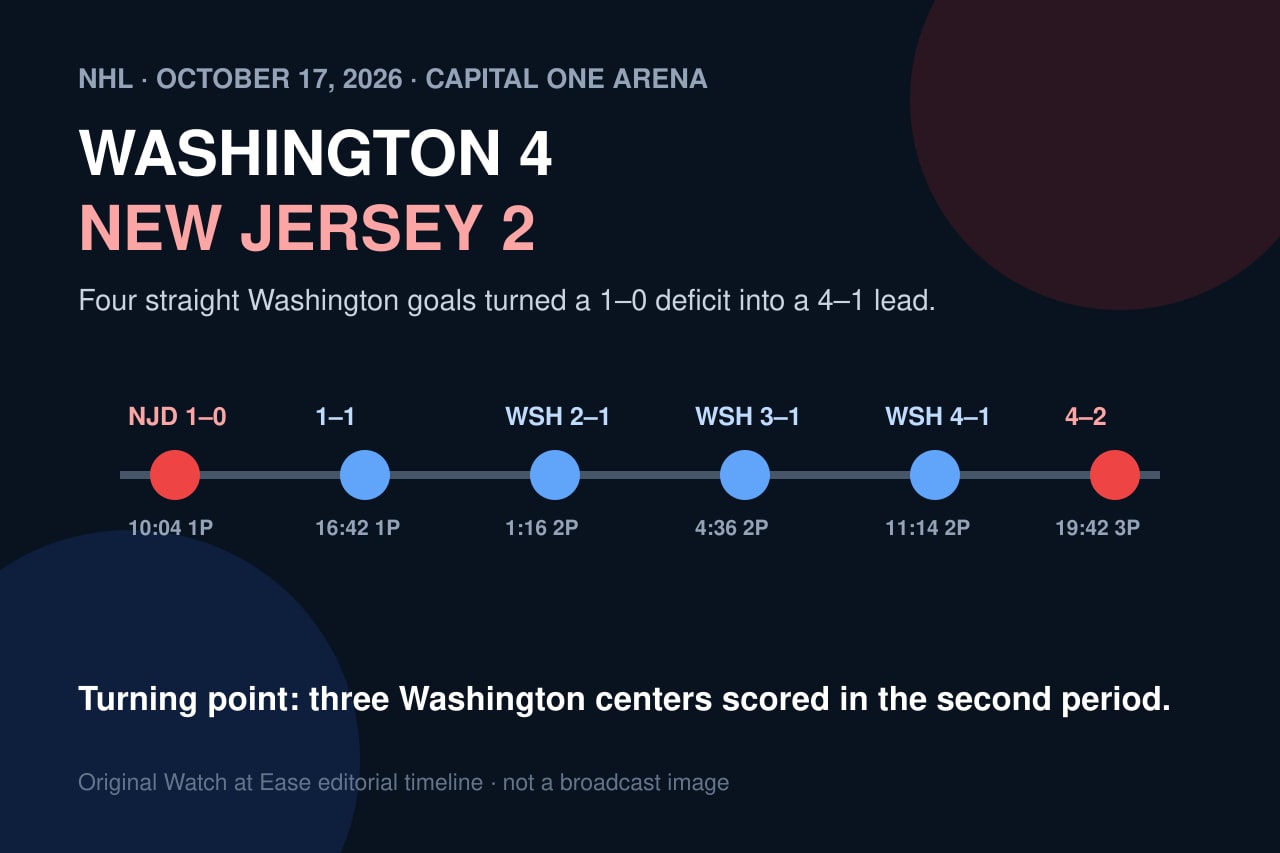
Washington defeated New Jersey 4–2 at Capital One Arena on October 17. The Devils scored first, but Ryan Leonard tied it late in the opening period before Ilya Protas, Dylan Strome and Boone Jenner turned a 1–1 game into a 4–1 Washington lead in the second.
Leonard changed the game before intermission
Arseny Gritsyuk put New Jersey ahead at 10:04 of the first period, one second after a Devils power play expired. Washington had created early odd-man chances but had not converted them.
With 3:18 left in the period, Ryan Leonard carried the puck from his own zone, split New Jersey’s coverage and finished a power-play rush to tie the game. Washington’s coach described the play as the moment that brought the building and bench back to life.
Three centers decided the second period
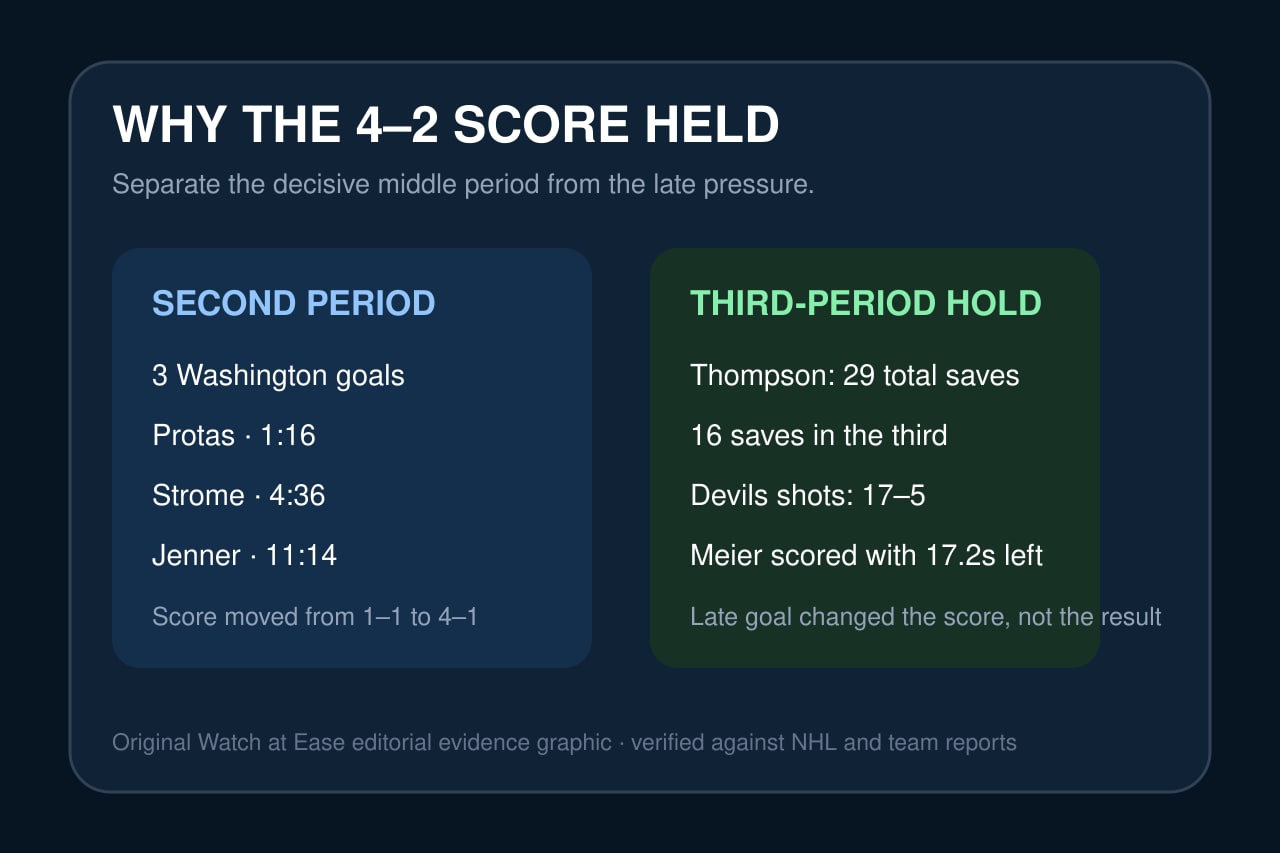
Ilya Protas scored 1:16 into the second period from an Alex Ovechkin feed. Dylan Strome made it 3–1 at 4:36 after all five Capitals touched the puck in the attacking sequence.
Boone Jenner added the third Washington goal of the period at 11:14, converting a rebound after an offensive-zone faceoff. The Capitals’ three available centers had now scored in the same period, moving the game from 1–1 to 4–1.
Thompson stopped the third-period push
New Jersey outshot Washington 17–5 in the third period. Logan Thompson made 16 of his 29 saves in that period, including several early chances that could have reduced the margin while significant time remained.
Timo Meier scored on a power play with 17.2 seconds left. The goal set the final at 4–2, but it arrived too late to change possession of the game.
The final was not a simple possession story
The Devils’ official report said shots, possession and scoring chances were close and identified Thompson as the difference. New Jersey’s own postgame account also isolated the second period as the failure point.
That distinction matters: Washington did not dominate every stretch. It converted the decisive window, then received high-level goaltending when New Jersey pushed back.
What carries into the next game
Washington improved to 5–3–0 and won a second straight game; New Jersey fell to 4–4–0 and had a two-game winning streak end. Those results are fixed.
Whether Washington can repeat the same center depth while injured players return, and whether New Jersey can avoid another costly middle-period lapse, remain forward-looking questions rather than conclusions from one game.