Technology · NEWS EXPLAINER
Cadence Maestro brings chip-design AI models on premises—but its biggest gains are still vendor claims
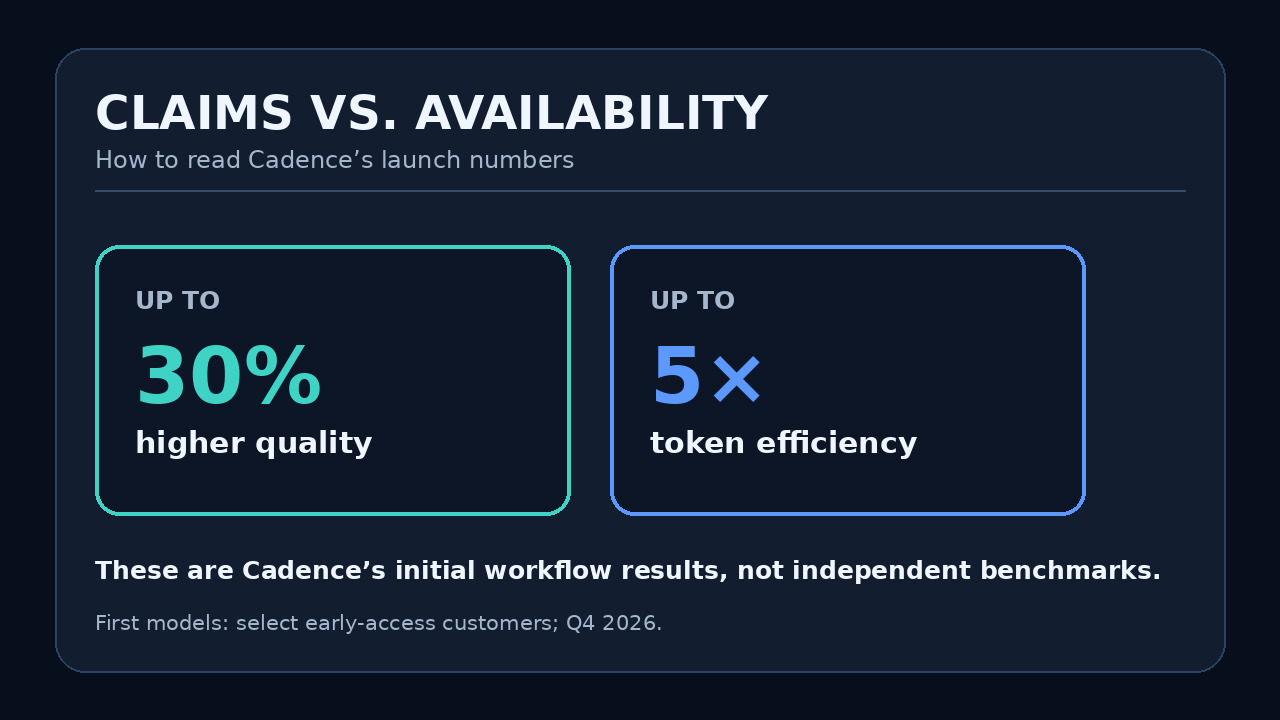
Cadence says Maestro can run in customer-controlled data centers and deliver up to 30% higher quality with five-times token efficiency; early access is limited and independent benchmarks are not yet public.
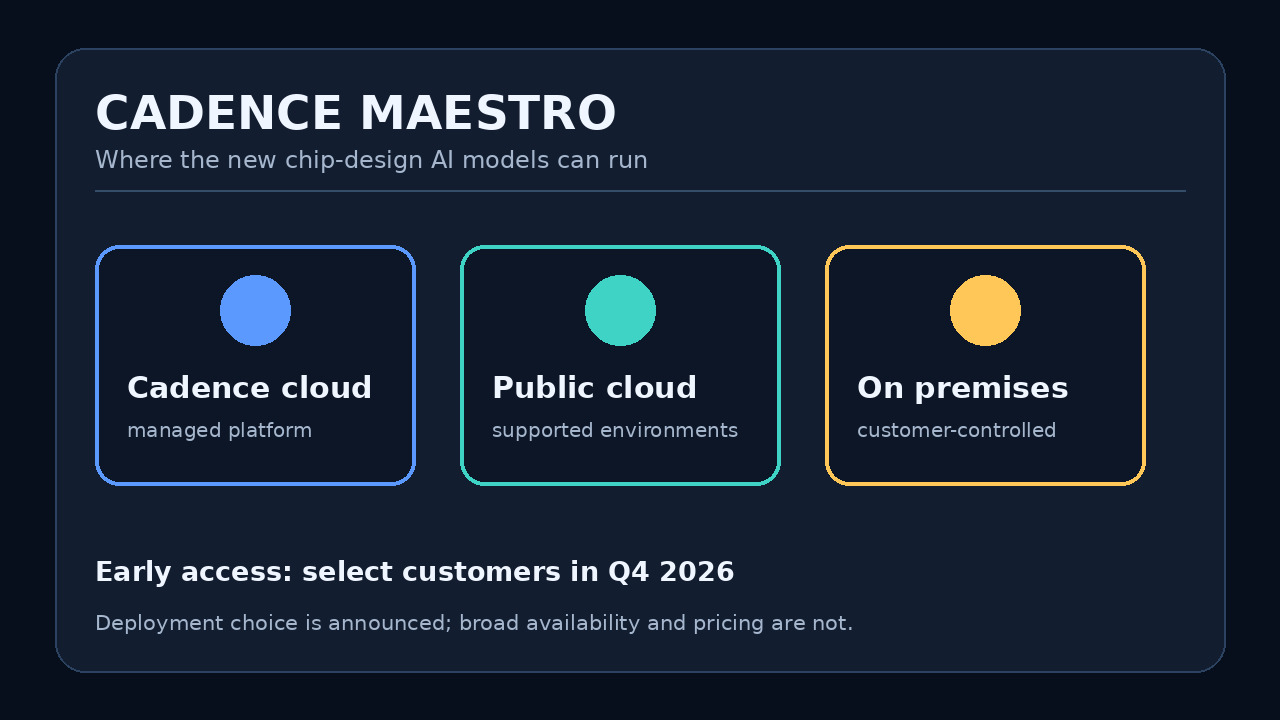
Cadence has launched Maestro, a portfolio of specialized AI models for semiconductor and system design that can operate in the cloud or inside a customer’s own infrastructure. The deployment options are concrete, but availability begins with select early-access customers.
The headline performance figures need a second label: they are Cadence’s initial workflow results, not broad independent benchmarks. Buyers still need model, pricing, security and workload-specific evidence.
What Cadence launched
Cadence introduced Maestro, a portfolio of domain-specialized models intended to power its chip- and system-design AI agents. The company says the portfolio includes post-trained language models, decision models and self-improving agent skills rather than one general chatbot.
Where customers can run it
Cadence says the complete environment can run in its managed cloud, supported public clouds or customer-controlled on-premises infrastructure. Reuters reports that customers can fine-tune models with their own chip designs, making deployment and data-control terms central evaluation questions.
How Nvidia fits in
The portfolio combines Cadence models with frontier and open-weight models. Reuters and Cadence say Nvidia Nemotron is included and Nvidia OpenShell is used in the agent-security architecture, but Cadence describes Maestro as model-agnostic rather than tied to one provider.
What the performance numbers mean
Cadence reports initial workflow results of up to 30% higher quality and up to five times greater token efficiency than a general-purpose foundation model. Those are vendor-reported, task-dependent results; the launch materials do not provide an independent benchmark suite, customer-by-customer results or pricing.
Availability is narrower than the announcement
The first Maestro models are scheduled for select early-access customers in the fourth quarter of 2026. That is not a broad general-availability date, and neither Cadence nor Reuters published a universal price or a complete customer eligibility list.
What engineering teams should verify next
Useful follow-up evidence includes which Maestro models ship, supported deployment configurations, data-retention and fine-tuning boundaries, licensing, benchmark definitions and results on a team’s own design flow. Until those details appear, deployment choice and claimed efficiency should not be read as proven production gains for every customer.