Science · NEWS EXPLAINER
Blue Origin targets weekly New Glenn launches—but its current license allows 12 a year
The company is expanding Florida factories, pads and payload facilities for multiple flights a week by the end of the decade. The FAA is reviewing a proposal for up to 50 annual launches; that is not approval yet.
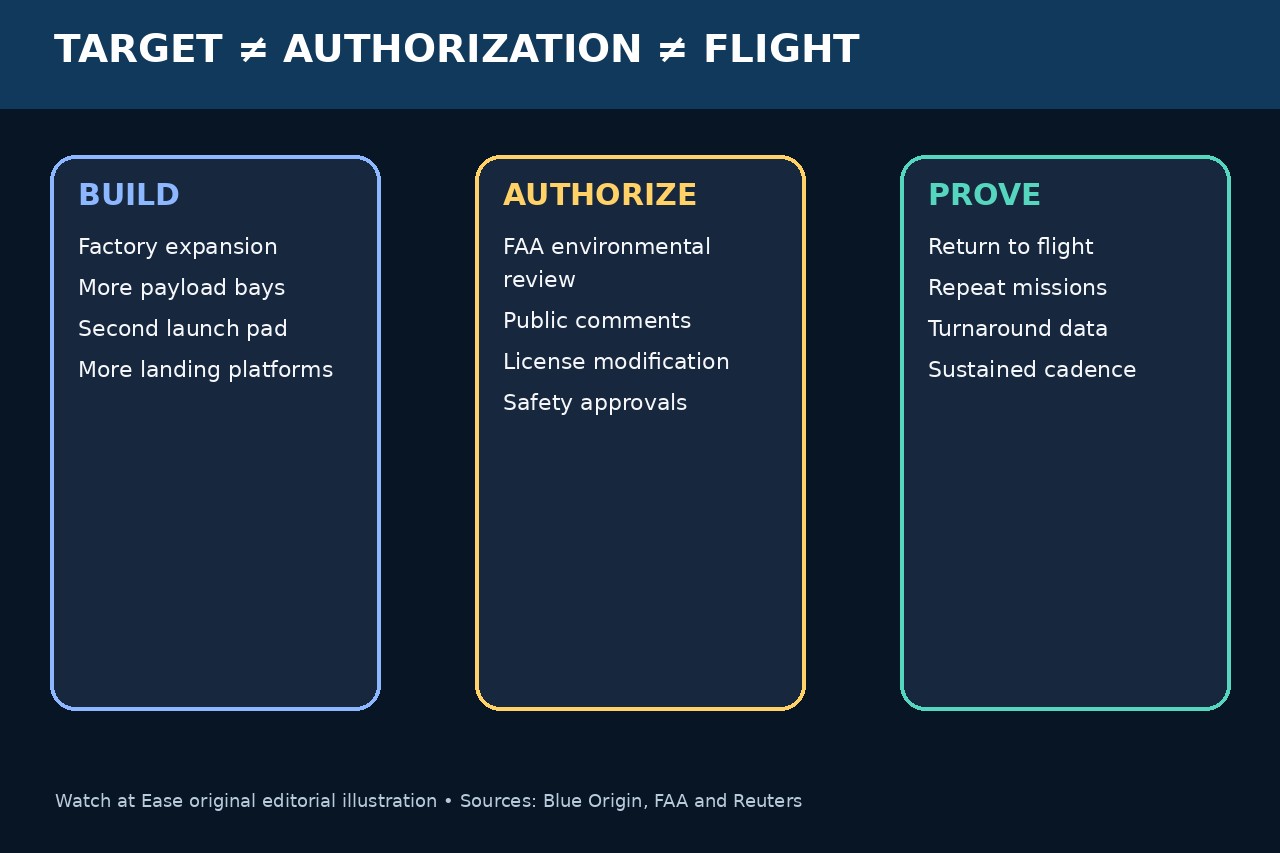
Blue Origin says its Florida expansion is designed to support multiple New Glenn flights per week by the end of the decade. The plan includes a $330 million factory expansion, more payload-processing space, a second launch pad and additional landing platforms.
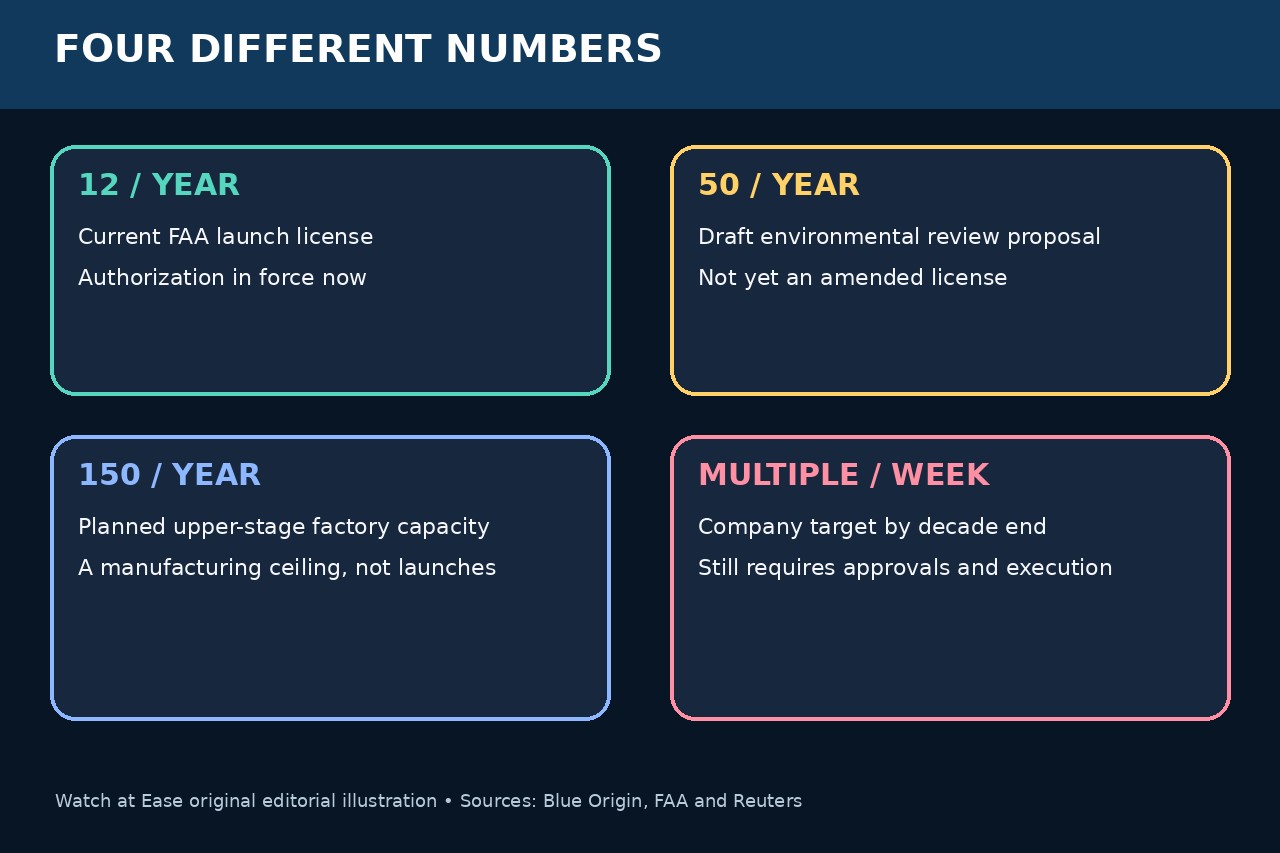
That goal is not current operating authority. The FAA says the existing license allows up to 12 New Glenn launches a year. A draft environmental assessment examines a proposal for up to 50, but the review and public-comment process do not by themselves amend the license.
What Blue Origin is building
Blue Origin says its Florida footprint exceeds 31 acres and 1.37 million square feet at Rocket Park. The $330 million expansion is planned to finish in summer 2027 and raise upper-stage manufacturing capacity to as many as 150 a year.
The company also describes four payload bays, two encapsulation bays, multiple-manifest processing, restoration work at LC-36A, construction of LC-36B and plans for two more landing platforms. These investments support higher throughput, but infrastructure capacity is not a flight record.
Why 12, 50 and 150 are not comparable
The FAA page says the license in force authorizes up to 12 launches annually. A draft environmental assessment studies increasing that number to 50, with public comments due October 30 and a public meeting on October 22. Environmental review is one step; it does not itself issue a modified license.
The figure of 150 refers to upper-stage factory capacity. It is not a launch license, a forecast of completed missions or proof that other rocket stages, pads, range operations and recovery systems can support the same rate.
The operational record is another gate
Reuters reports New Glenn has been grounded since a May explosion damaged the launch pad and is expected to return early next year. An April mission also failed to reach its intended orbit because of a second-stage problem and later re-entered.
Those events do not disprove a long-term cadence target, but they show why readers should separate a designed rate from a demonstrated rate. Repeated missions, turnaround times and successful recovery operations will provide the evidence that a weekly rhythm is sustainable.
What to watch next
The next measurable steps are completion of the environmental review, any license modification, progress on LC-36B and the factory expansion, and an actual return to flight. Blue Origin’s multiple-flights-per-week language is explicitly a target for the end of the decade, not a schedule for the next mission.
For launch customers and local residents, the practical documents are the effective FAA license and environmental decisions. Company infrastructure announcements show intent and investment, but authorization and operating performance determine what can actually fly.