Technology · NEWS EXPLAINER
BeyondTrust Remote Support flaw is being exploited—who is already patched and who must act
CVE-2026-102764 can let a remote, unauthenticated attacker perform file operations on an appliance. Remote Support SaaS was patched by October 9; self-hosted systems through version 26.2.3 need a version and patch check.
NHS England issued an active-exploitation alert on October 16 for CVE-2026-102764, a critical flaw in BeyondTrust Remote Support. The vendor says weak origin validation in an internal messaging component can let a remote attacker perform file operations on an affected appliance.
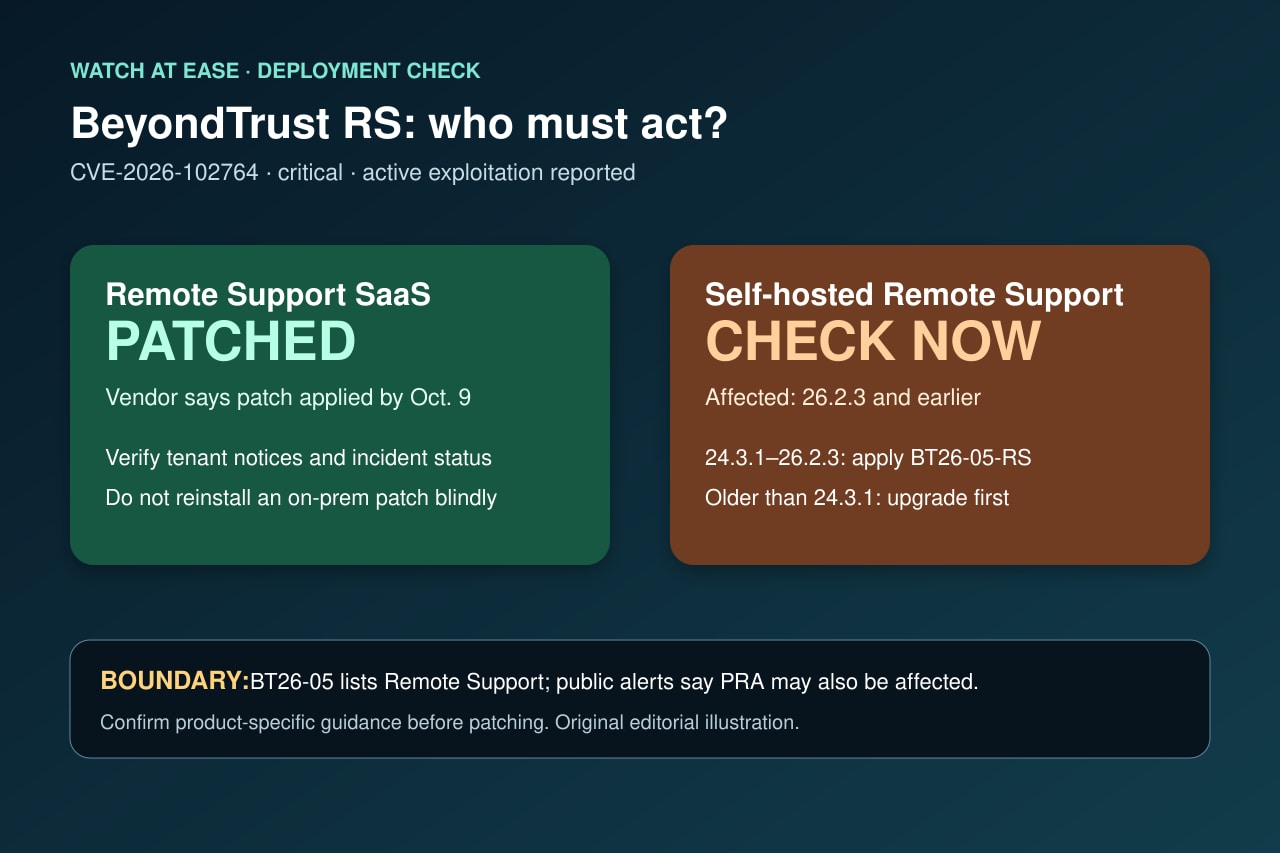
The practical response depends on deployment type. BeyondTrust says it patched all Remote Support SaaS customers by October 9. Self-hosted customers should verify whether automatic updates applied the fix; Remote Support 26.2.3 and earlier is affected, and systems older than 24.3.1 must upgrade before the listed patch can be applied.
What changed on October 16
The vendor disclosed the vulnerability on October 15. On October 16, NHS England published an active-exploitation alert, said custom malware and web shells had been observed, and assessed further exploitation as highly likely. That same-day defensive alert is the material development: organizations now have evidence that this is not only a high score on paper.
Reuters reported that Google Threat Intelligence Group and Mandiant tied August exploitation of the then-unknown flaw to a suspected China-linked group called Armory Castle. Attribution can evolve, but the operational point is stable: exploitation preceded public disclosure, and defenders should not treat patch installation as proof that an appliance was never compromised.
SaaS and self-hosted customers are in different positions
BeyondTrust says a patch was applied to all Remote Support SaaS customers as of October 9. That statement concerns the hosted service and does not mean every privately managed appliance has the fix. SaaS customers should still review vendor notices and their own incident status, but they should not assume they must manually install the on-premises package.
For self-hosted Remote Support, the advisory lists every version through 26.2.3 as affected. It provides the BT26-05-RS patch for versions 24.3.1 through 26.2.3; customers on anything older must upgrade to a newer release before they can apply it. Automatic-update subscribers should verify completion rather than infer it.
What the flaw can enable—and what remains bounded
BeyondTrust describes inadequate origin validation that can permit file operations on an appliance. Reuters says successful exploitation can expose credentials, allow arbitrary file uploads and lead to control of the host. NHS England reports observed custom malware and web shells. Those consequences make remote-support appliances especially sensitive because they sit near privileged workflows.
The public vendor advisory specifically names Remote Support in its affected-product table. NHS England says BeyondTrust advised that Privileged Remote Access may also be affected. That is a reason to seek product-specific guidance, not a basis for silently applying the Remote Support patch to a different product.
A safer response order
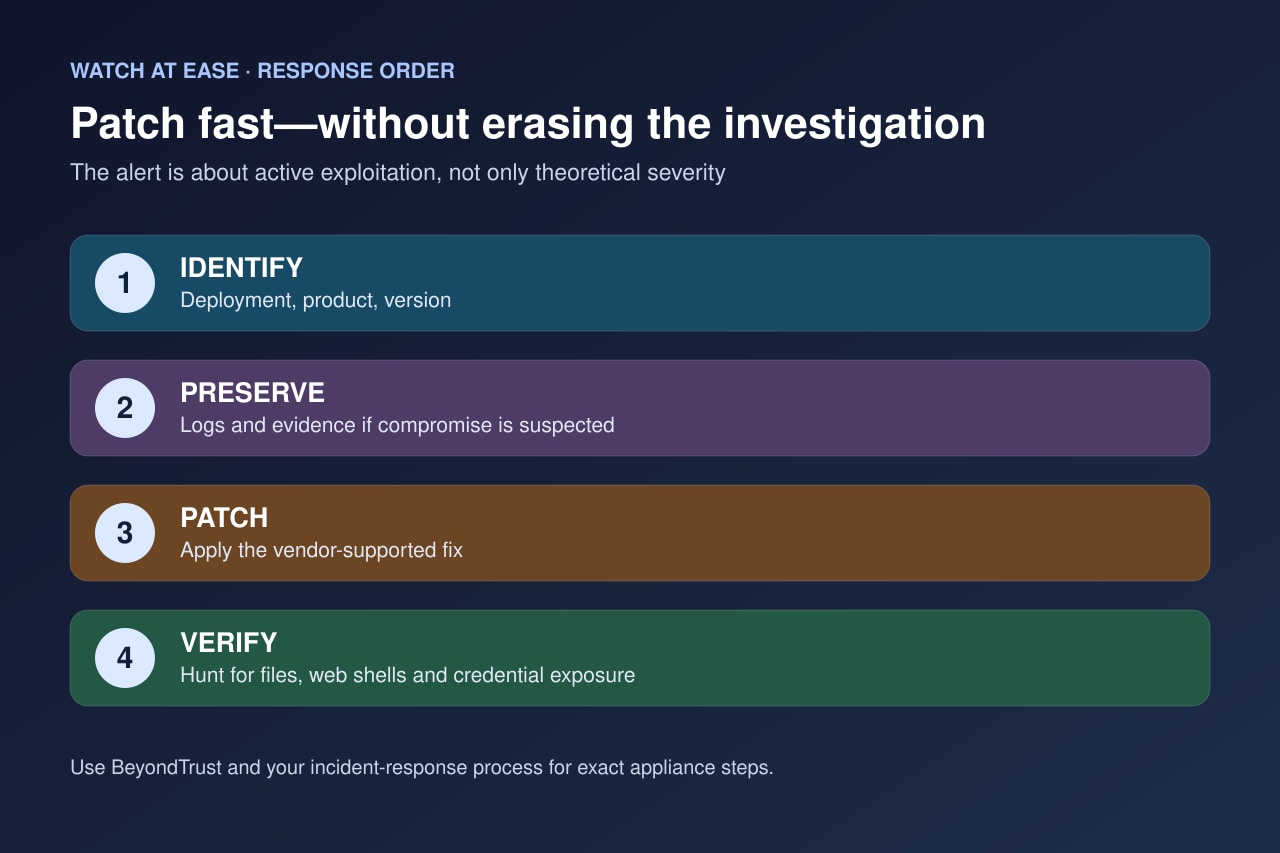
First inventory deployment type, product and exact version. If compromise is suspected, involve the incident-response owner and preserve the evidence required by that process before making changes that may overwrite logs. Then follow BeyondTrust’s supported upgrade and patch path; do not use an unofficial fix or expose the appliance further to test it.
After patching, check for indicators of unauthorized file placement, web shells, new accounts or credential access using vendor and incident-response guidance. If privileged credentials may have been exposed, coordinate containment and credential rotation after establishing a clean control path. Patching closes the known flaw; it does not automatically remove an earlier foothold.