Technology · NEWS EXPLAINER
ASML hybrid-bonding report hits Besi shares—but a commercial tool is not confirmed
SemiAnalysis says 27 patent families point to an ASML die-to-wafer hybrid bonder. Reuters reported a roughly 3% fall in Besi shares, while ASML declined to confirm the product.
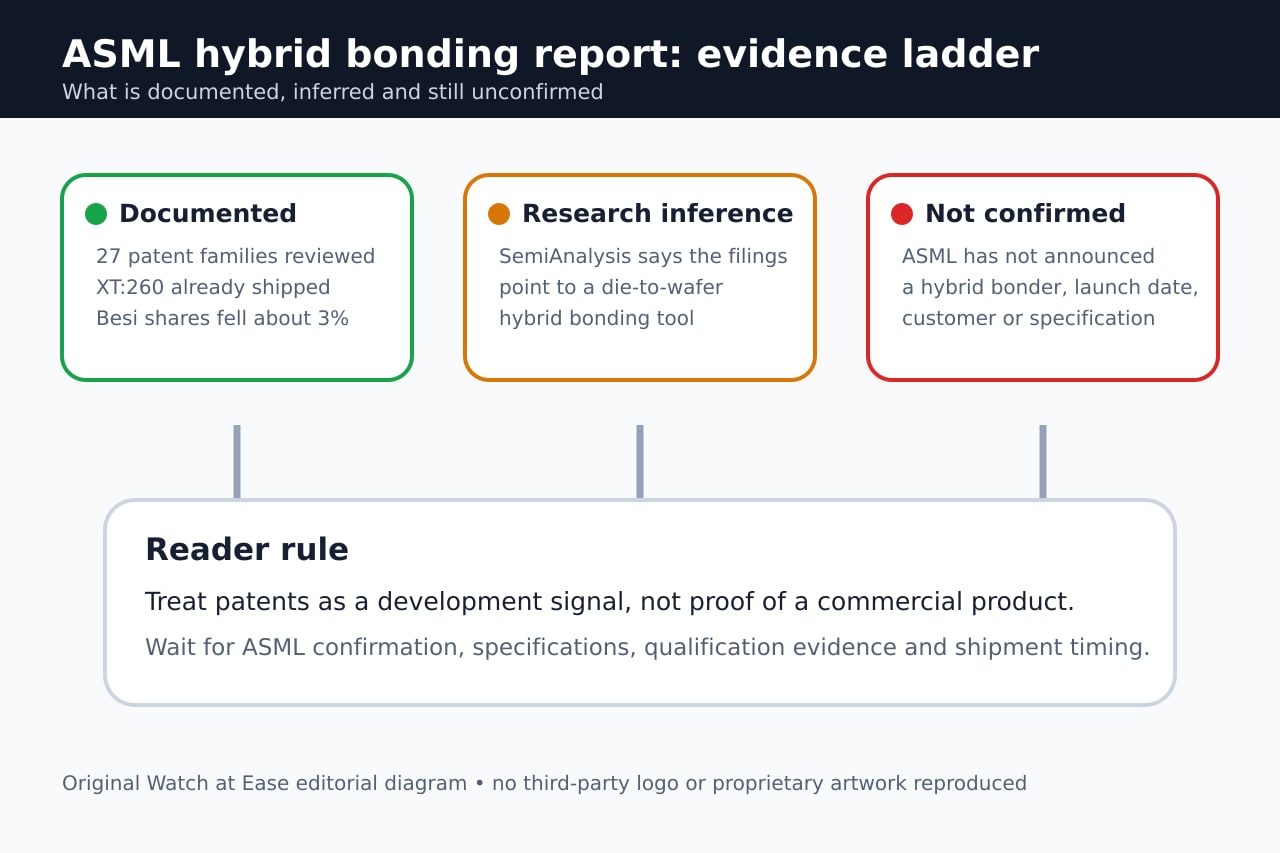
A patent-based report has raised the prospect of a new competitor in hybrid bonding, an advanced packaging process used to connect dies with very fine-pitch links. SemiAnalysis says 27 ASML patent families filed from December 2022 through November 2024 indicate development of a die-to-wafer bonding system.
That is a research conclusion, not a product announcement. Reuters reported that Besi shares fell about 3% on October 16, while ASML declined to comment on the report and has not confirmed a hybrid-bonding tool.
What triggered the move
SemiAnalysis published a technical analysis arguing that ASML is building a die-to-wafer hybrid bonding tool. Its public report cites 27 patent families filed between December 2022 and November 2024 and describes a track-based concept that moves individual dies through inspection, cleaning, activation, metrology and bonding stations.
Reuters reported that Besi shares fell around 3% after the analysis. Besi is a leader in hybrid-bonding equipment, so a credible new entrant could alter expectations for a product central to its growth story.
What ASML has—and has not—said
ASML did not confirm the reported product. Reuters said a spokesperson declined to comment on the analysis but pointed to the company’s existing advanced-packaging work.
ASML’s 2025 annual report says it shipped the TWINSCAN XT:260, its first advanced-packaging product, and would explore further opportunities in 3D integration. That establishes strategic interest, but it does not confirm a hybrid bonder, specifications, launch date, customers or volume production.
Why hybrid bonding matters
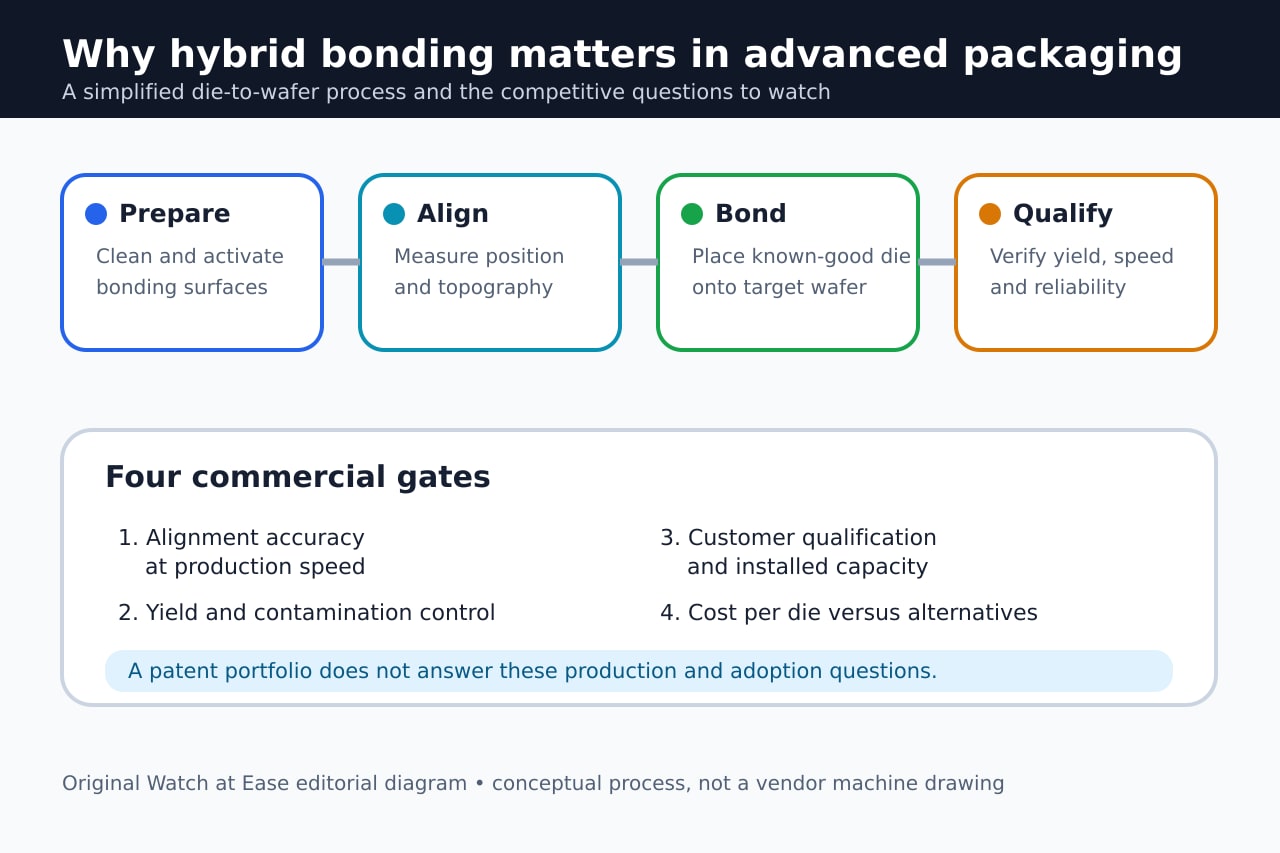
Hybrid bonding joins prepared surfaces to create dense electrical connections without relying only on traditional bumps. Die-to-wafer systems must align known-good dies accurately while sustaining cleanliness, yield and throughput.
SemiAnalysis argues that current die-to-wafer volume production is limited and that alignment and throughput remain major constraints. Those engineering and economic gates matter more than the existence of patents alone.
What to watch next
The strongest confirmation would be an ASML product announcement with performance specifications, followed by customer qualification, shipment timing and evidence of production yield. Until then, the patent analysis should be treated as a development signal.
Besi’s current position is also measurable. Its July results said hybrid-bonding customers increased from 15 at the end of 2025 to 21 by the end of the second quarter of 2026, with use cases spanning logic, memory, co-packaged optics and consumer applications.