Technology · NEWS EXPLAINER
Apple Photos “faceprints” case heads toward an April 2027 jury trial
A judge let most biometric-privacy claims proceed, but did not find Apple liable. The dispute now turns on what Photos creates, whether it can identify people and who controls encrypted data.
Apple faces an April 2027 jury trial after a federal judge in Illinois refused to dismiss most claims that its Photos app creates and stores “faceprints” without the notice and consent required by the state’s biometric privacy law, Reuters reported on October 16. Apple denies wrongdoing.
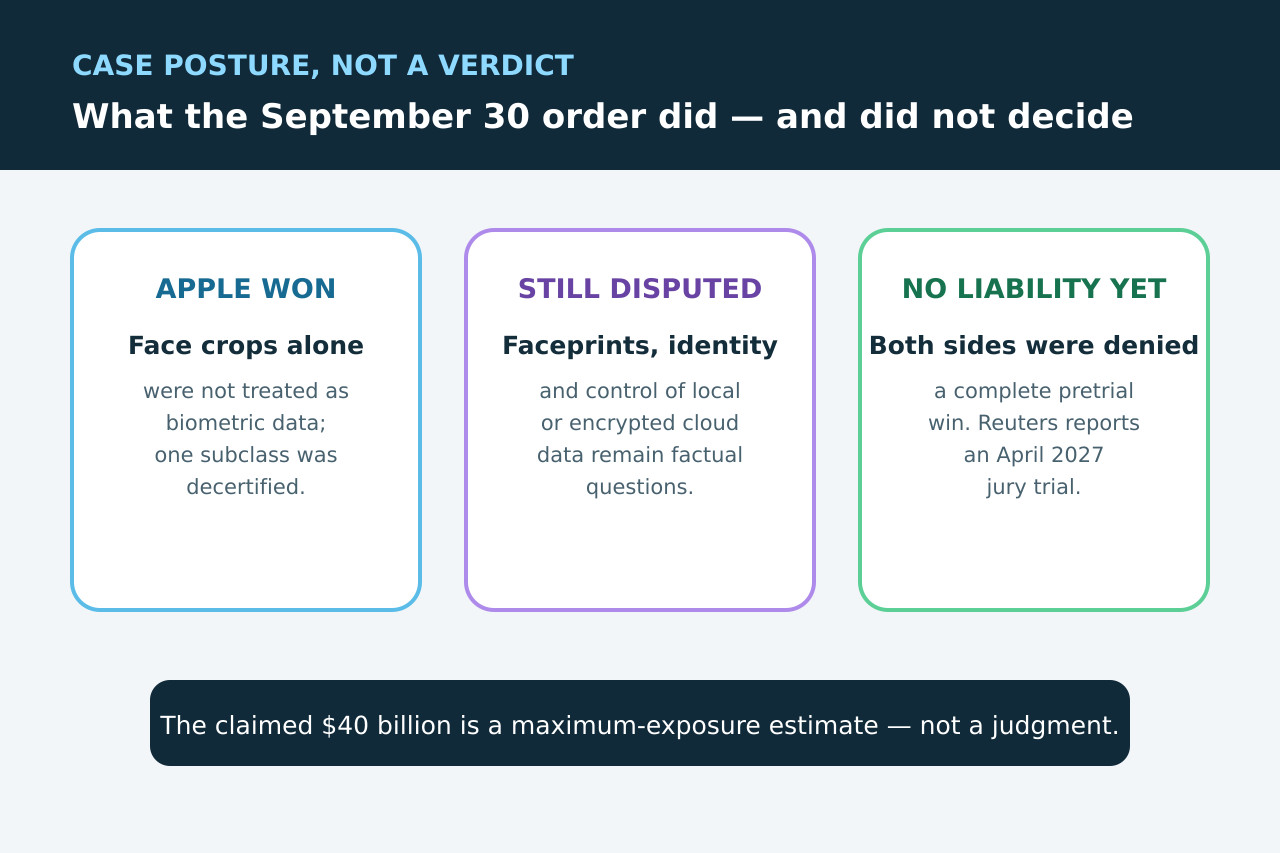
The September 30 order is not a verdict. Apple won on one narrower issue involving cropped face images, and one subclass was decertified. Questions about the 128-number faceprints, their ability to identify people and Apple’s control over local or encrypted cloud data remain for a jury.
What the judge allowed to continue
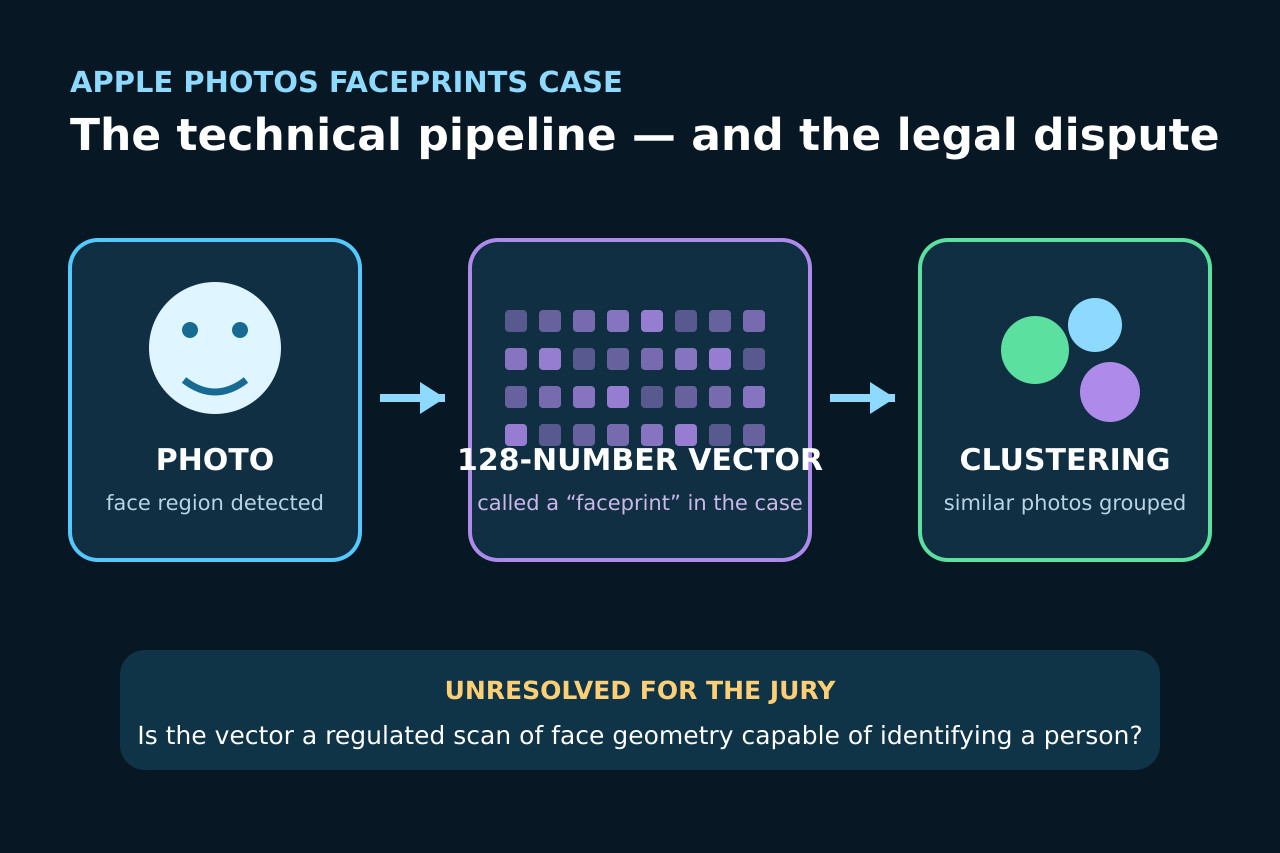
The case, Doe v. Apple, concerns the Photos app’s People or People & Pets grouping feature. The record described by the court says a neural network creates a 128-number embedding from a face crop and clustering software groups similar embeddings. The parties and Apple documents refer to those vectors as faceprints.
Judge Nancy Rosenstengel found enough competing evidence for a jury to decide whether a faceprint is a “scan of face geometry” under the Illinois Biometric Information Privacy Act and whether it is capable of identifying a person. Denying summary judgment means those questions survive; it does not mean the plaintiffs proved them.
Apple won one part and lost an early exit on others
The court sided with Apple on face crops. It found that a cropped image, by itself, was not the alleged biometric identifier and decertified the former iCloud subclass whose theory rested on crops and related metadata. Those people remain within the broader local-device class, according to the detailed order analysis.
Most of Apple’s summary-judgment motion was denied, while the plaintiffs’ bid for partial summary judgment was also denied. The remaining local-device and iCloud-faceprint theories therefore proceed without a liability finding for either side.
Why encryption did not end the control question
Apple argued that encrypted iCloud data it cannot read is not under its control. The judge concluded that a jury could still find control because Apple operates the software and servers and can determine how data is created, stored, encrypted, changed or deleted. The court’s reasoning focuses on operational power, not simply whether Apple can currently decipher the bytes.
The order analysis also distinguishes data that stays on a device from faceprints transmitted to iCloud after a July 2024 synchronization update for qualifying users. Whether Apple controls on-device faceprints remains disputed. The ruling did not find that faceprints were exposed, stolen or read by an outside party.
How to read the April 2027 trial and damages figures
Reuters reported on October 16 that the judge scheduled an April 2027 trial. A separate October 10 analysis of the September 30 order stated that the order itself set no trial date, so the April date reflects a later scheduling development rather than text in that order. Readers should not combine the two publication dates into a contradiction about the ruling.
Lawyers for the plaintiffs estimate a class of about 8 million Illinois residents. Multiplying that estimate by BIPA’s maximum $5,000 amount for an intentional or reckless violation produces $40 billion. That is a theoretical ceiling presented by advocates: no jury has found a violation, selected a mental state or awarded damages. The trial will decide facts still in dispute, and later motions or appeals may follow.