Technology · NEWS EXPLAINER
Apple HomeView launches at $299: personal access and wall mounting need separate checks
The new shared display recognizes household users, but personal requests depend on a compatible paired device. Wall mounts and some services add costs beyond the screen.
Apple introduced HomeView on October 13 as a new household display, with U.S. prices of $299 for either the tabletop or wall-mounted model and availability planned for November 13. Pre-ordering the screen is only part of the decision: personalized access, installation and content each have separate requirements.
The practical question is whether the household needs a shared screen that can become personal when its owner is recognized. Before choosing a location, check the people, compatible devices and services it will actually use.
A shared display has several kinds of access
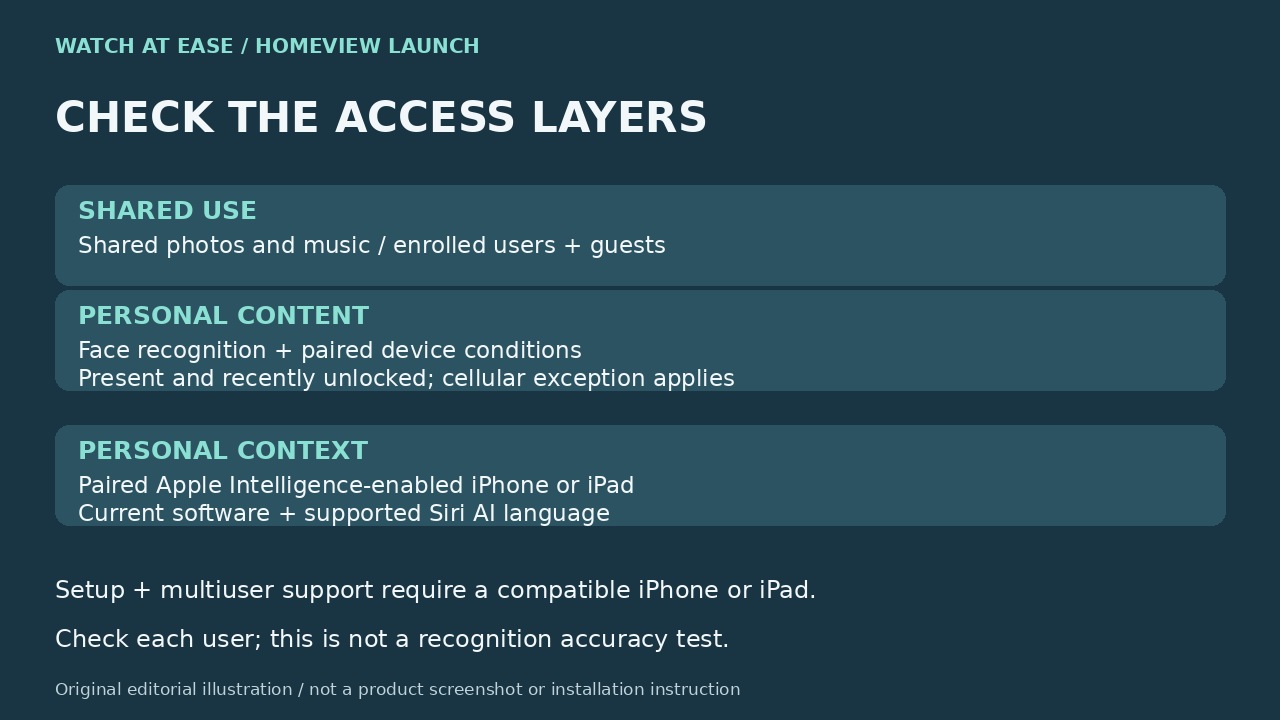
Hartley Charlton’s original MacRumors launch report describes a 7-inch display that changes the amount of information shown with the user’s distance and recognizes up to six people. It separates personal home screens from shared photos and music available to guests. That distinction is more useful than assuming that every person walking into the kitchen gets the same account access.
Map the intended uses before installation. Shared music, a video call, a household control and a personal message are different tasks. Ask who will use each one and which account supplies it. A convenient shared location should not be chosen on the assumption that the device replaces every household member’s phone or that guest access includes everyone’s personal information.
The phone still matters for personal requests
Apple says setup and multiuser support need a compatible iPhone or iPad on current software. Personal-context requests require a paired Apple Intelligence-enabled device with Siri AI enabled in a supported language. Personal content is gated by face recognition and a present, recently unlocked paired device. A footnote permits a cellular-connected exception when that device was recently on the same Wi-Fi, remains in the same location and was recently unlocked.
Techlicious’s independent analysis separates general questions and conversation from phone-dependent personal actions. It flags that compatible hardware can add a cost outside the display price. Check every intended user’s device rather than infer eligibility from one family member’s newest phone. We have not tested recognition accuracy, the precise unlock interval or how these conditions behave in a particular household.
Wall mounting changes the price and the timing
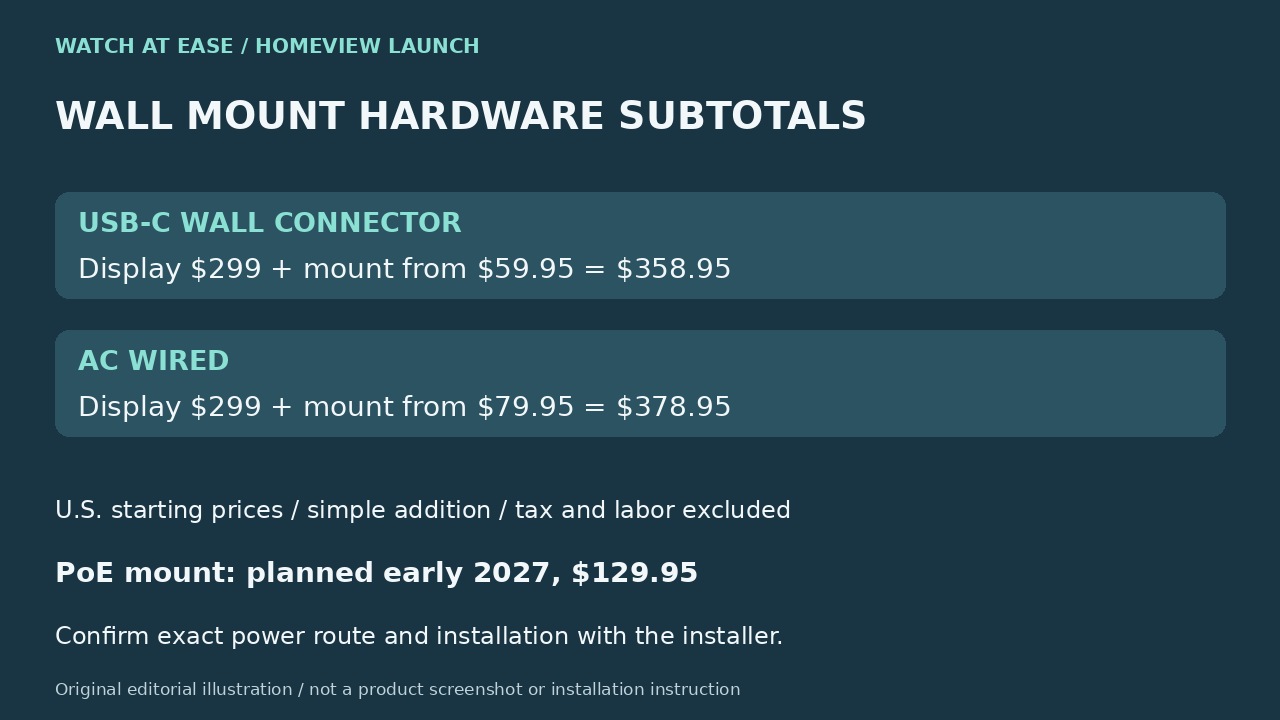
Apple lists separate Schneider Home mounts: USB-C Wall Connector from $59.95 and AC Wired from $79.95, orderable at announcement, with PoE Wired planned for early 2027 at $129.95. These are U.S. starting prices for mounts, not complete installation quotes. The wall-mounted display itself is still listed at $299.
For planning, adding the listed USB-C starting price gives a $358.95 hardware subtotal before tax and any other costs; the AC starting price gives $378.95. Those are our simple additions, not retailer offers. Choose the required power route with the installer and confirm the exact mount, labor and availability. Do not assume the later PoE option arrives with November’s display launch or undertake electrical work from a news diagram.
A screen is not a promise of every app or camera service
Techlicious notes that Apple names compatible third-party audio and video apps without giving a complete launch list in the announcement. Its expectations about future apps remain the author’s opinion. Verify a must-have service directly rather than assume that a household screen includes the same software selection as an iPad.
Apple’s footnotes also separate paid content, compatible smart-home accessories and eligible iCloud+ camera features. Region and language limits remain, and the announcement excludes EU sales. Inventory the actual camera, lock, service and phone before treating the $299 display as the full cost of the system. Our diagrams explain access layers and mounting subtotals; they are original illustrations, not screenshots, recognition tests or installation instructions.