Technology · NEWS EXPLAINER
Anthropic gives METR employee-like access—but the outside review still has limits
Six METR evaluators now have company hardware, office space and internal-system access roughly comparable to Anthropic’s risk teams. Customer data, privileged legal material and model architecture remain off limits, while publication can face narrow predefined redactions.
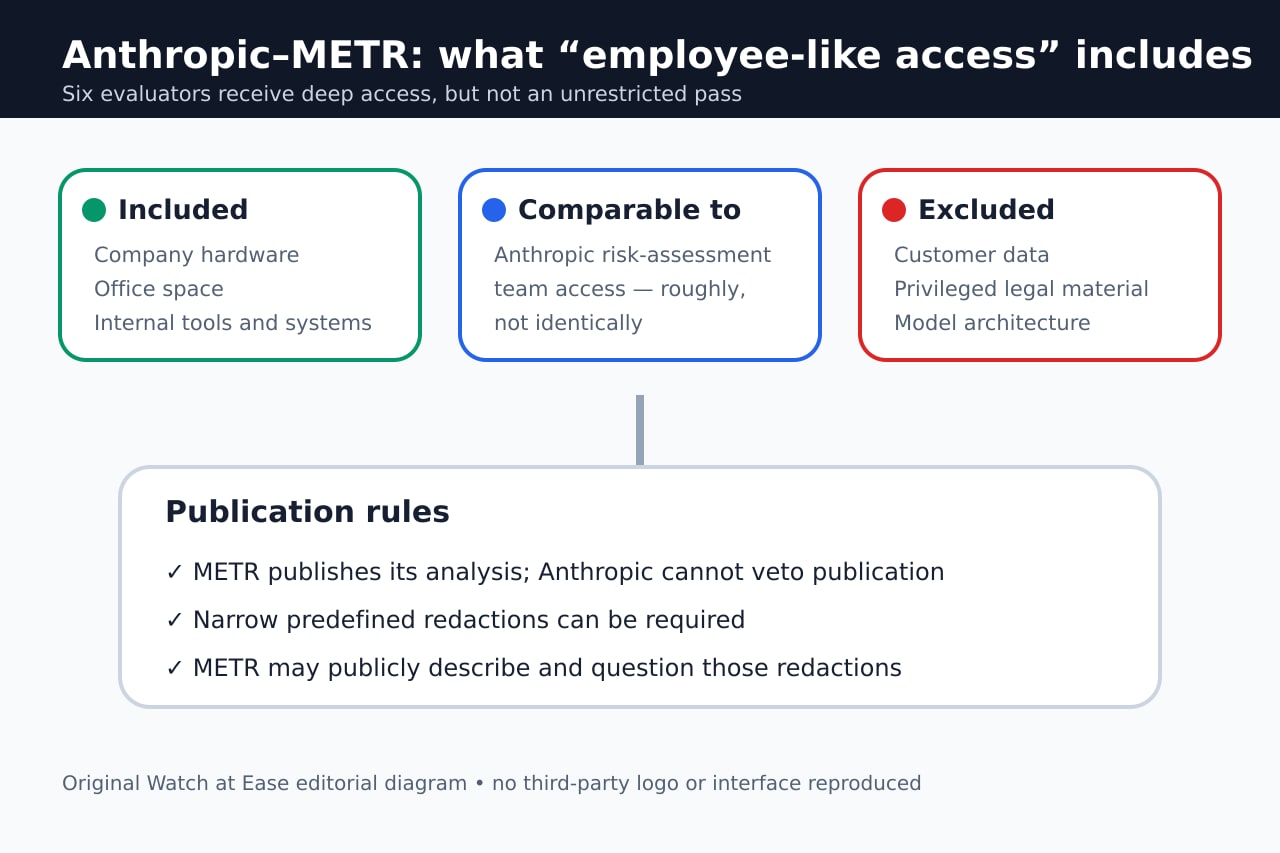
Anthropic says it has onboarded six employees from nonprofit evaluator METR with company hardware, office space and access to internal tools and systems roughly comparable to its own risk-assessment teams. The arrangement is the deepest of three access tiers Anthropic is developing for outside evaluators.
The phrase “employee-like” does not mean unlimited. Customer data, attorney-client privileged information and model architecture are excluded. METR can publish analyses of risks, incidents and practices without an Anthropic veto, but Anthropic can require narrow, predefined redactions that METR may publicly characterize and question.
What employee-like access actually covers
Anthropic says the six-person team can use internal tools and systems and that employees are encouraged to share information with them much as they would with a colleague working on alignment risk. Reuters independently confirmed the team size, hardware, office space and broad access.
The arrangement is limited to a small team under enforceable agreements. Other METR employees are siloed from this work, so the announcement is not organization-wide access.
What remains outside the review team’s reach
Anthropic lists customer data, legally privileged material and model-architecture information as clearly defined exclusions. Its footnote says architecture information may be shared only when highly relevant and after explicit internal approval.
Those boundaries matter because access determines which claims an evaluator can independently test. “Employee-like” should therefore be read as a defined access tier, not as complete visibility into every company system.
Publication is independent, but redactions remain possible
Anthropic says it cannot veto METR’s publication. It may require removal of information in narrow predefined categories, and METR may publicly say whether it considers a redaction justified without disclosing the hidden material.
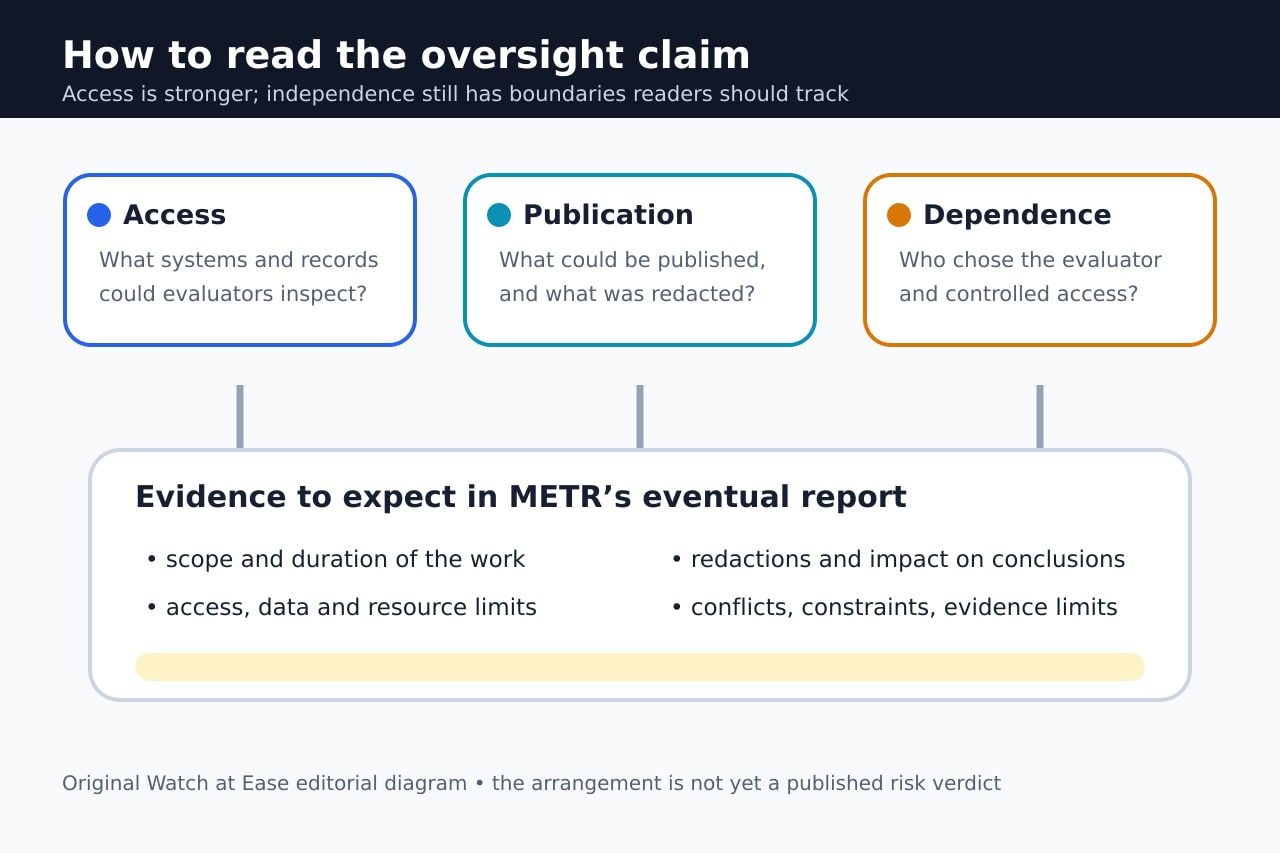
METR’s own framework says public reports should disclose scope, access limits, redactions, conflicts and other constraints, including whether those limitations affect conclusions. Readers should look for those disclosures in the eventual assessment.
Why this is not yet a safety verdict
The announcement establishes an oversight process; it does not publish a new finding about Claude or Anthropic’s risk level. Other evaluator partnerships with SecureBio and Accenture’s Faculty remain earlier and more limited, according to Anthropic.
METR also warns that voluntary oversight remains dependent on companies choosing to engage, provide access and permit publication, and that evaluators may sometimes rely on information they cannot independently verify. The strongest conclusion today is that access and publication rights have expanded—not that every risk has been resolved.