Sports · NEWS EXPLAINER
Diriba breaks Amsterdam course record; Berhanu wins three seconds outside men's mark
The Ethiopian winners had different record outcomes: Diriba ran 2:16:12, while Berhanu's 2:03:33 beat Nicholas Kipkorir by six seconds but left the men's course mark intact.
Buze Diriba broke the women's course record at the Amsterdam Marathon on October 18, winning in 2:16:12 in wet conditions. Lemi Berhanu completed an Ethiopian double with 2:03:33, a six-second victory that fell three seconds outside the existing men's course record.
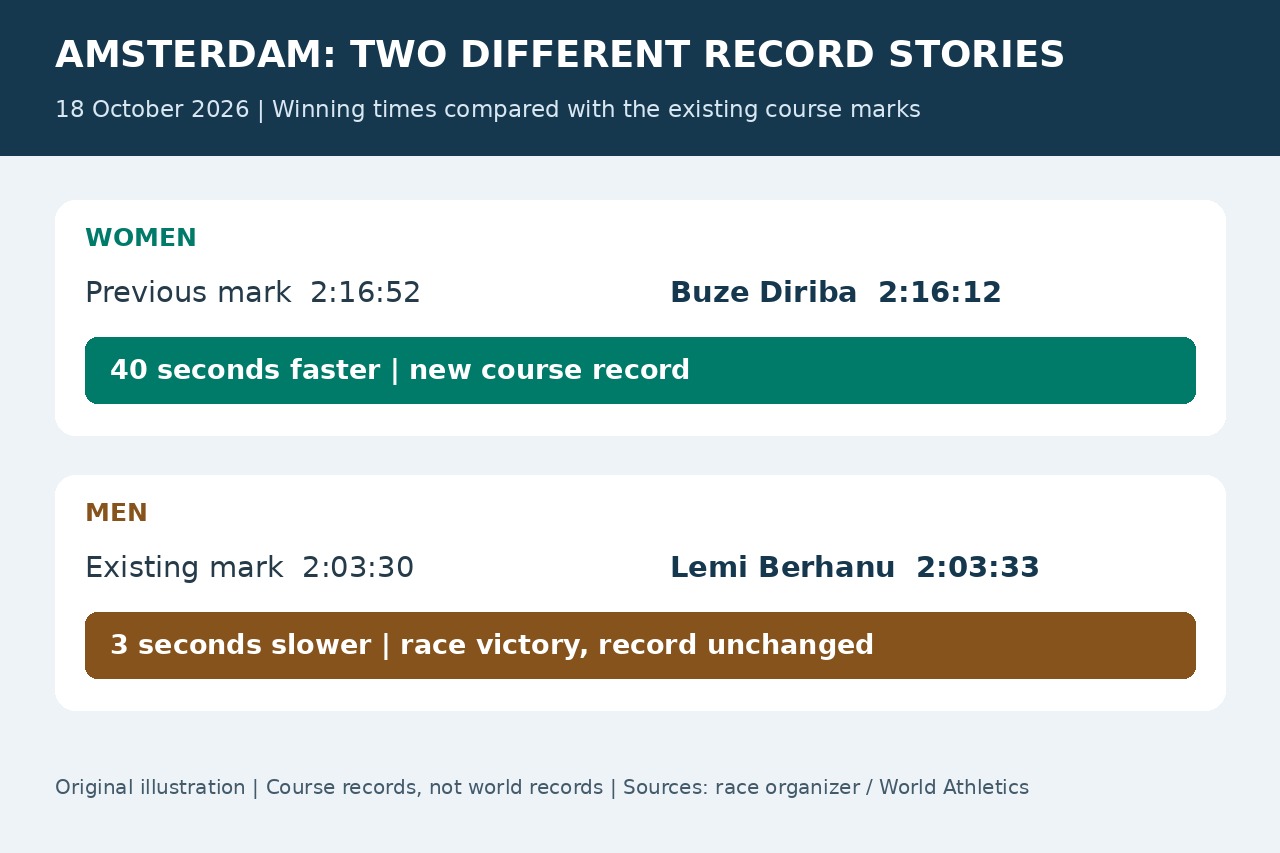
The distinction matters when reading the results: Diriba improved the Amsterdam women's mark by 40 seconds; Berhanu set a personal best and won the race while the men's course mark remained 2:03:30. The organizer, World Athletics and the independently published Marathon Handbook results agree on both winning times.
Two victories, two record outcomes
Diriba lowered the women's course record set by Yalemzerf Yehualaw in 2024 from 2:16:52 to 2:16:12. World Athletics also identified the performance as a Dutch all-comers' record. A course record concerns this race; it should not be described as a world record.
Berhanu's 2:03:33 was three seconds slower than the 2:03:30 Geofry Toroitich Kipchumba ran the previous year. Berhanu still took a minute off his previous personal best of 2:04:33. Race victory, personal improvement and a course record describe separate achievements.
Diriba's late separation secured the women's mark
World Athletics reported that Diriba, Desta, Mestawut Fikir and Belete reached halfway in 1:08:34 and 30km in 1:37:23. Fikir then lost contact, before Diriba and Desta moved clear of Belete. Diriba made the decisive separation and was about half a minute ahead at 40km.
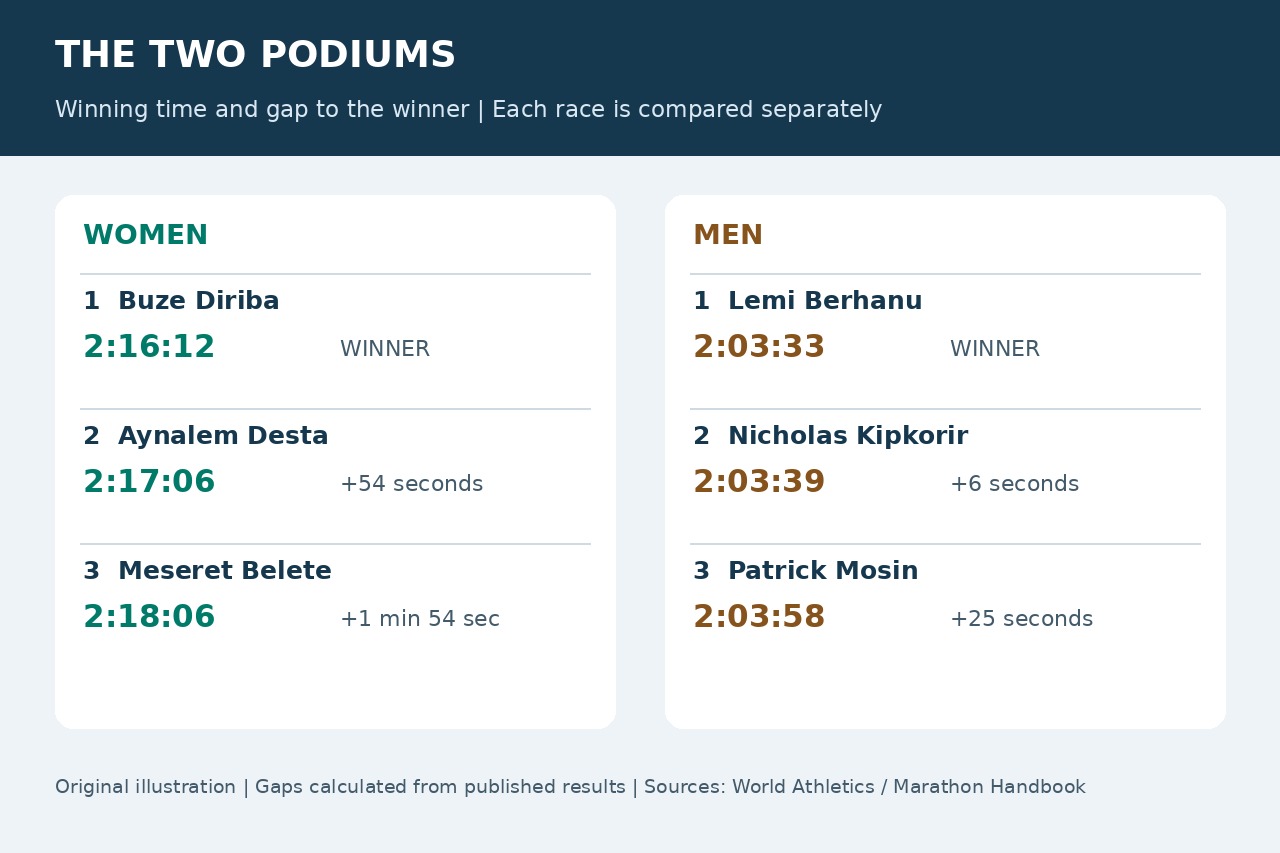
She extended the advantage to 54 seconds at the finish. Defending champion Desta was second in a personal-best 2:17:06, with Belete third in a personal-best 2:18:06. Diriba improved her own previous best of 2:19:34 by 3 minutes 22 seconds. Those differences are calculated from the published finish times.
Berhanu settled the men's duel in the closing stretch
The men's leading group passed halfway in 1:02:24. Later, Kipkorir accelerated near the Vondelpark and Berhanu went with him. World Athletics described the pair shoulder to shoulder at 40km in 1:57:25, with Mosin 11 seconds behind at that checkpoint.
Berhanu then edged ahead and finished in 2:03:33. Kipkorir followed in 2:03:39 and Mosin in 2:03:58: gaps of six and 25 seconds to the winner. The finish order and times match the separately published Marathon Handbook results. The 11-second gap at 40km is a checkpoint margin, rather than Mosin's final deficit.
The podiums and depth put the results in context
Ethiopia swept the women's first three places, led by Diriba, Desta and Belete. The men's podium paired Ethiopian winner Berhanu with Kenyans Kipkorir and Mosin. The first eight men's finishing times were below 2:05, a measure of the depth behind the close contest at the front.
This report uses the published elite winning times and the existing course marks consistently. It does not infer individual halfway splits from a lead-group checkpoint or turn rain into a claim about what caused the fast performances. The confirmed outcomes are a new women's course record, an unchanged men's course record and two Ethiopian race winners.