Business/Technology · NEWS EXPLAINER
AI data-center buildout lifts U.S. warehouse demand as asking rents reach $10.55
JLL says support companies are clustering near major data-center projects, while average industrial asking rents rose 3.2%. The national figures still hide a split between large Class A space and older buildings.
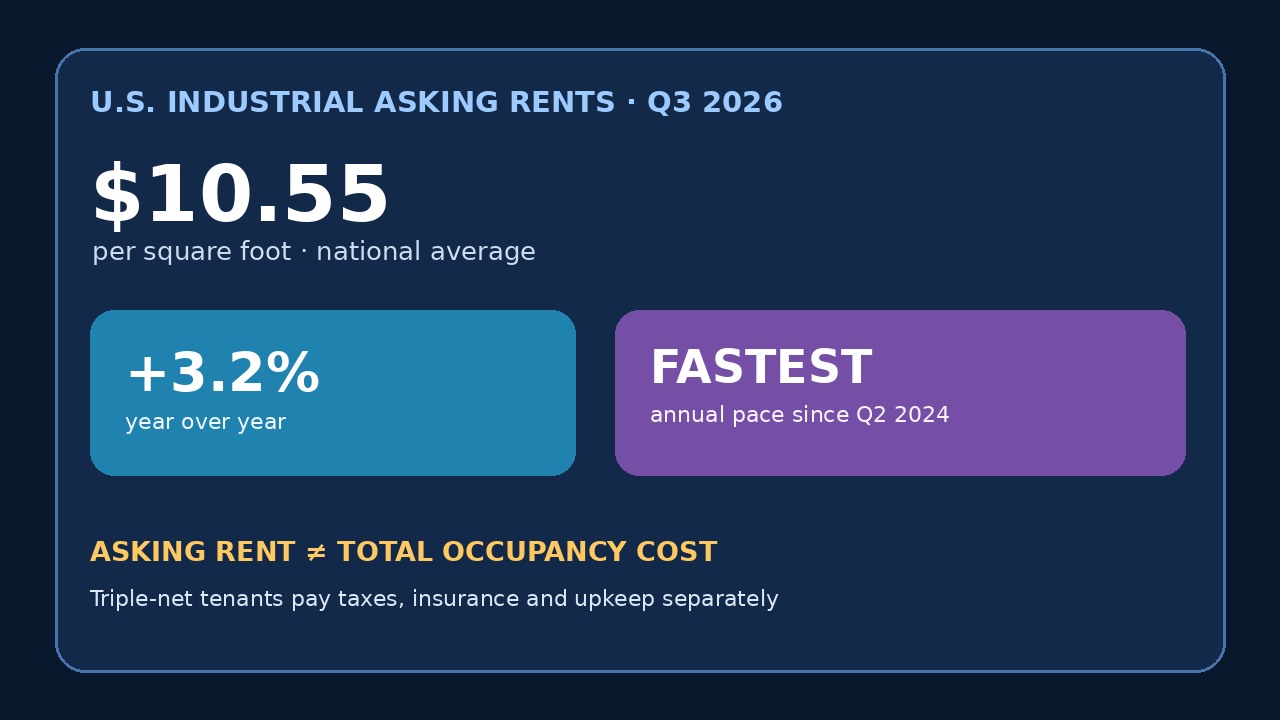
Artificial-intelligence data-center construction is creating a new layer of U.S. warehouse demand, especially around Dallas-Fort Worth and Washington, D.C., JLL said in its third-quarter industrial-market report. National average asking rents reached $10.55 per square foot, up 3.2% from a year earlier.
The rent figure is an average asking rate for triple-net leases, not the entire occupancy cost or proof that every warehouse market rose at the same pace. JLL says tenants under those leases separately cover property taxes, insurance and common-area upkeep.
Data-center suppliers are clustering near major projects
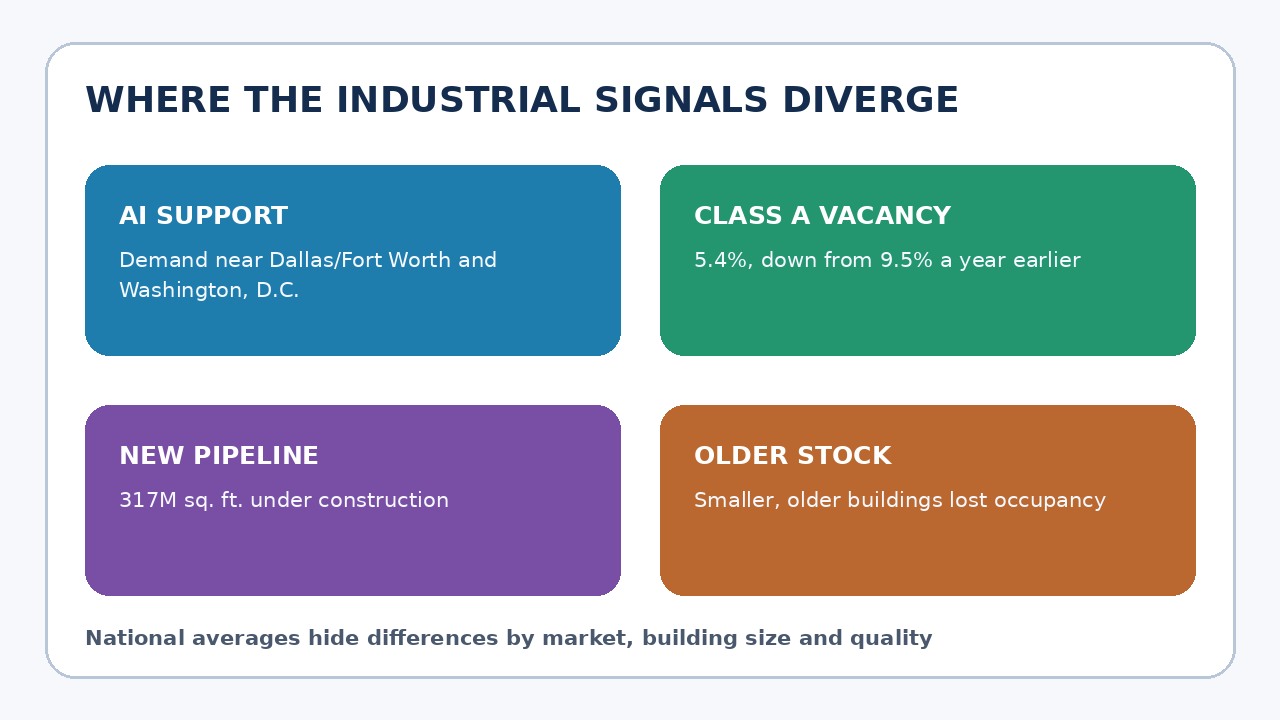
JLL says suppliers and infrastructure providers are clustering near hyperscale data-center campuses, producing outsized industrial demand in freight hubs such as Dallas-Fort Worth. Reuters also identifies Washington, D.C., as a market where data-center construction is generating warehouse demand. The linkage is indirect: support companies need nearby storage, staging and distribution space.
Average asking rents reached $10.55 per square foot
JLL's national average asking rent rose 3.2% from a year earlier to $10.55 per square foot, the fastest annual growth since the second quarter of 2024. The figure is a market average based on asking rents, not a completed lease for every building or a universal rate in each city.
Triple-net pricing excludes several occupancy costs
The quoted rent is based on triple-net leases. In that structure, tenants typically pay property taxes, insurance and common-area maintenance separately from base rent. A reader comparing sites therefore needs the all-in occupancy cost rather than treating $10.55 as a complete bill.
Large modern warehouses tightened while older stock lagged
JLL reports vacancy for Class A warehouses larger than one million square feet fell to 5.4% from 9.5% a year earlier, while older and smaller buildings lost occupancy. That split means national rent growth does not describe equal demand across building age, size or quality.
The construction pipeline expanded to 317 million square feet
Developers increased the U.S. industrial pipeline to 317 million square feet under construction, up 28.7% year over year and 14.8% from the previous quarter, the highest since the first quarter of 2024. That future supply may ease some constraints, but it is not yet completed space and delivery timing can change.